Thinking about going tankless? Here's what installation actually costs in Cook County, IL — and why the number you've seen online probably doesn't apply to your home.
Share:
Request a Callback
Want to skip the wait?
Simply enter your contact details, and we’ll call you when a Go Rooter Advisor becomes available.
Summary:
You’ve already decided you want a tankless water heater. You’re not here to be sold on the technology — you’re here because you want to know what it’s actually going to cost in Cook County, IL, and whether the quote you’re about to get (or already got) is in the right ballpark.
That’s a smart place to start. The national averages floating around online don’t account for Cook County’s labor rates, older housing infrastructure, or local permit requirements — and that gap is exactly where homeowners get caught off guard. Here’s what the real numbers look like, what drives them, and what a fair, honest quote in this market should include.
Most Cook County homeowners pay somewhere between $5,500 and $8,500 for a gas tankless water heater, fully installed. Electric tankless systems run $4,500 to $7,500. Those numbers are significantly higher than the $2,577 national average you might see online — and there’s a real reason for that gap.
The unit itself is only 30 to 50 percent of the total project cost. The rest is labor, venting, permits, and — in a lot of Cook County homes — infrastructure upgrades that nobody told you about until the plumber was already in your basement. That’s the part worth understanding before anyone shows up at your door.

Cook County has some of the oldest residential housing stock in the Midwest. Chicago’s bungalows, two-flats, and greystones — and the brick ranches and cape cods filling the inner-ring suburbs from Berwyn to Calumet City — were built mostly before 1970. That era of construction comes with infrastructure that was never designed for modern tankless water heaters.
Gas tankless units require significantly higher BTU input than traditional tank heaters. If your existing gas line is undersized — which is common in older Cook County homes — it needs to be upgraded before the new unit can run safely and efficiently. That work typically adds $200 to $800 to the project. Venting is another common issue: single-wall flue pipe and older B-vent systems aren’t compatible with most tankless units, and replacing them adds another $200 to $800 depending on what’s there and how accessible it is.
For electric tankless systems, the challenge is usually the electrical panel. A whole-home electric tankless unit draws significant amperage — often more than a 100-amp panel (standard in pre-1970 Cook County homes) can handle. A panel upgrade to support it can run $300 to $900 before the water heater installation even begins. That’s not a contractor padding the bill — it’s a code requirement, and any licensed plumber worth hiring will tell you upfront.
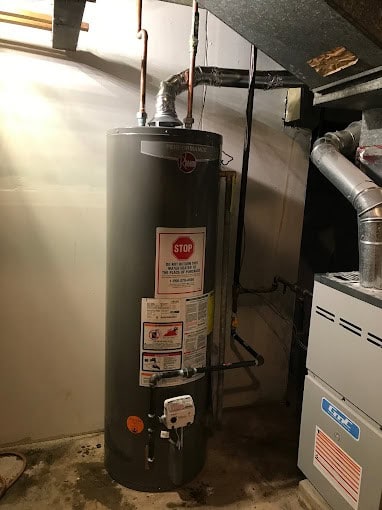
Then there’s disposal. Removing and hauling away an old tank water heater — especially a large one in a tight Chicago basement — can add $500 or more depending on size and access. Permits are required for tankless installation throughout Cook County, and those fees range from $30 to $250 depending on scope.
None of these are surprises if you know to ask about them. The problem is most homeowners don’t know to ask — and some contractors don’t volunteer the information until the job is already underway.
About 80 percent of Cook County homes are connected to natural gas. That’s not a coincidence — it’s the dominant energy infrastructure in this market, and it shapes which system makes the most practical sense for most homeowners.
Gas tankless units have a clear advantage in whole-home applications. They deliver higher flow rates, heat water faster, and don’t require the kind of electrical infrastructure upgrades that electric whole-home systems often demand in older Cook County homes. The unit itself costs more — typically $1,000 to $2,600 for the equipment alone — but the installed performance in a home with existing gas service is usually worth it.
Electric tankless water heater installation makes more sense in specific situations: a single bathroom addition, a garage or workshop with no gas line, or a point-of-use system under a sink. For whole-home use in Cook County, electric tankless often runs into the panel capacity problem described above, and the flow rate limitations can be a real issue during a Chicago winter when incoming groundwater temperatures drop significantly — meaning the unit has to work harder to reach the same output temperature.
The right answer depends on your home’s existing infrastructure, your household’s hot water demand, and what upgrades are already needed. That’s exactly why a proper assessment before the quote matters — not a guess from a phone call, but someone who’s actually looked at your gas line, your panel, and your venting before giving you a number.
Want live answers?
Connect with a Go-Rooter Emergency Plumbers expert for fast, friendly support.
A complete, honest quote for tankless hot water heater installation in Cook County should cover the unit, labor, any required gas line or electrical work, venting modifications, old unit removal, and permit fees — all in writing, before the job starts. If a quote you receive doesn’t break those out, ask for it in writing. The ones that don’t tend to be the ones that grow once the work begins.
We’ve been doing this work across Cook County since 2001, and the single biggest source of homeowner frustration isn’t the price itself — it’s the gap between what they were told and what they were eventually charged. Upfront, itemized pricing isn’t just a courtesy; it’s the baseline for a professional job.
Yes — and this applies throughout Cook County, not just the City of Chicago.
In Chicago proper, the city runs one of the most stringent plumbing codes in the country. Switching from a tank water heater to a tankless system almost always triggers a permit requirement because it involves changes to venting, gas supply, or both. Chicago’s Easy Permit Program can handle straightforward in-kind replacements with same-day approval, but a tankless conversion typically falls outside that scope. A permit is required, and it must be pulled by a licensed contractor — not the homeowner.
In suburban Cook County, the Department of Building and Zoning requires permits for water heater work, with inspections to follow. In unincorporated areas of the county, the local health department may serve as the authority having jurisdiction. Regardless of where in Cook County you are, this work requires a permit, and any plumber telling you otherwise is either uninformed or cutting corners.
Under Illinois law (225 ILCS 320), all water heater installation must be performed by a licensed plumber. The City of Chicago additionally requires licensed contractors to carry a $20,000 surety bond. These aren’t bureaucratic formalities — they’re protections for you as a homeowner. Unpermitted work can void your homeowner’s insurance coverage, create liability issues when you sell, and leave you responsible for code violations discovered later.
When we handle a tankless installation in Cook County, permits are part of the job. The fee is in your quote, we pull the permit, and we coordinate the inspection. You don’t have to chase anyone down.
Yes, and most homeowners in Cook County don’t take full advantage of them.
If you’re in Nicor Gas’s service territory — which covers much of suburban Cook County — you may qualify for a $150 rebate on a qualifying high-efficiency tankless water heater. It’s real money and takes minimal effort to claim when your contractor provides the right documentation.
On the federal side, the Inflation Reduction Act created meaningful tax credits for qualifying high-efficiency water heaters. High-efficiency gas tankless units may qualify for a credit of up to $600. Heat pump water heaters — a different category, but worth knowing about — can qualify for up to $2,000. These are credits, not deductions, which means they reduce your tax bill dollar for dollar.
Cook County’s hard water environment is also worth factoring into your long-term cost picture. Mineral buildup from the region’s moderately hard water will shorten the life of a tankless unit without annual descaling maintenance — a service that typically runs $100 to $250 per visit. It’s not optional if you want the unit to last its full 15 to 20 years. A water softener, if you don’t already have one, can significantly reduce that maintenance burden, though the upfront cost ($1,200 to $3,500 installed) is a separate decision.
The comparison that matters most for most Cook County homeowners: a properly maintained tankless unit lasts 15 to 20 years. A traditional tank water heater, under the same hard-water conditions, typically makes it 8 to 12 years. That lifespan difference, combined with annual energy savings of $150 to $250, is where the long-term value of going tankless actually lives — not in a single dramatic monthly bill reduction, but in a longer replacement cycle and lower operating cost over time.
The bottom line is this: tankless water heater installation in Cook County costs more than the national average, and it costs more for legitimate reasons — older infrastructure, strict permitting requirements, and higher labor costs in one of the country’s largest urban markets. A quote that accounts for all of that upfront, in writing, is a quote you can trust.
What you want to walk away from this page knowing is what should be in that quote: the unit, the labor, the venting, any gas line or panel work, old unit removal, and permit fees. If any of those are missing, ask. A plumber who’s done this work in Cook County for decades won’t hesitate to explain every line.
If you’re ready to get a real number — not a ballpark from a website, but an actual assessment of your home and what it needs — Go-Rooter Emergency Plumbers offers free quotes, same-day availability, and upfront pricing that doesn’t change once the job starts. Give us a call at 773-661-4800 and we’ll tell you exactly what you’re looking at.
Article details:
Share:
Continue learning:
Request a Callback
Want to skip the wait?
Simply enter your contact details, and we’ll call you when a NY Spine Advisor becomes available.