24/7 thawing, done safely
The city and the suburbs
Dolton, Brookfield, Markham, Skokie, Evanston and the rest of Cook County, not just the city limits. You are not calling a Chicago-only outfit from the suburbs.
Certified on Chicago housing stock
Our technicians work these pipes every winter, from pre-war two-flats to slab-on-grade ranches, so locating the freeze is not guesswork.
Open at 3 AM in January
Frozen pipes do not wait for business hours. Someone answers 24 hours a day, every day of the year, holidays included.
We say when it is not ours to fix
If the trouble sits on the City's side of the shut-off valve under the parkway, we tell you and point you to who owns it instead of billing you for it.

The third step is the one people skip
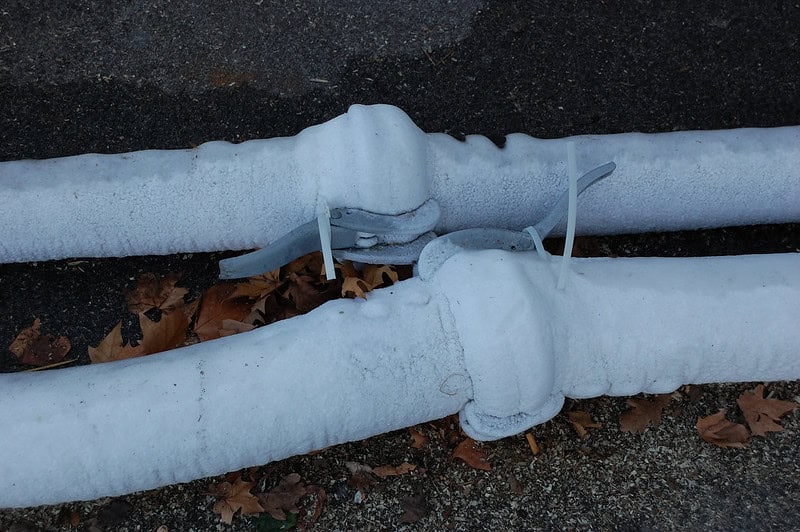
Frozen pipe repair in Chicago is three jobs, not one: finding which section of pipe is blocked with ice, thawing it with heat controlled enough not to split the metal, and then checking the line for the crack the ice already made. Skip that third step and the leak turns up hours later, usually inside a wall. The cause is almost always one of three things, and naming it decides whether the same run freezes again next week: a length of pipe with no insulation on it, frigid air moving through a crawlspace or against an exterior wall, or a structural gap letting cold straight into the cavity. If your pipe has already burst and water is coming out, start with burst pipe emergency plumbing instead.
Hear From Our Customers
No water today, no burst in February

Share project details
Call us or get a free online quote to help us identify your project needs.

We'll follow up
Sent an online quote request? We call you back to go over the details. Emergency? Call 773-661-4800, we answer 24/7.

The floor is yours
Connect with an expert and share all project specifics.

Plan your project
Like what you hear? We'll provide next steps and expert guidance.

Shut off, open up, keep the flame away
Three moves protect the house before anyone arrives. First, find your main water shut-off valve and make sure you can actually close it: in Chicago homes it is usually in the basement near the street-facing wall where the service line comes in, and in a condo it is often in a utility closet. Second, open the faucet that the frozen pipe feeds and leave it open, so melting ice has somewhere to go and pressure cannot build behind the blockage. Third, keep the heat gentle. A hair dryer or a heating pad on an exposed run is fine, as long as you are not standing in water and nothing electrical is near it. A propane torch, a kerosene heater or a gas burner is a common way a do-it-yourself thaw ends in a fire or a split pipe, and our guide on safe thawing methods versus risky DIY goes through which tools are safe and which are not. If water is already running out of the pipe, close the main valve and follow our step-by-step emergency guide.
What drives the bill, and when it is not your bill
There is no flat price for a frozen pipe, because the cost is set by where the ice sits rather than by the thawing itself. A reachable run in a basement or a crawlspace is the low end. The bill climbs when the pipe is behind drywall or under a slab and has to be opened up to reach, and climbs again when the ice has already split a section, which becomes a replacement of the damaged section rather than a thaw. You get the number before any work starts, which is the only honest way to price a job nobody can see yet. One thing worth knowing before you pay anybody: your water service line has two owners. The City of Chicago owns and maintains the run from the water main to the external shut-off valve, which usually sits under the parkway, and everything from that valve into the building belongs to the property owner. So if the trouble is on the City’s side of that valve, it is not a bill you owe a plumber. In Chicago, report it to 311. In a suburban Cook County village, call that village’s own water department. Which pipes go first is predictable in Chicago housing stock, and our guide on why frozen pipes strike Chicago homes every winter names the usual suspects.

Find the freeze
We trace the cold run and narrow the blockage down to a section, rather than heating pipe at random and hoping.
Thaw it safely
Controlled heat along the frozen length, worked from the faucet end back, so the melt water always has somewhere to go.
Check for the split
Water back on and the line watched, because a pipe the ice already cracked only starts leaking once it thaws.