Not all frozen pipe fixes are equal. Some methods thaw your pipes safely. Others cause the burst you were trying to prevent.
Share:
Request a Callback
Want to skip the wait?
Simply enter your contact details, and we’ll call you when a Go Rooter Advisor becomes available.
Summary:
It’s early morning, the temperature outside is sitting at 18°F, and you turn on the kitchen faucet to get nothing but a faint groan. You already know what that means. The question isn’t whether your pipe is frozen — it’s whether it’s still intact, and what you do next is going to determine whether this stays a $300 problem or becomes a $15,000 one.
Cook County winters don’t give much margin for error. Here’s what you actually need to know before you touch anything.
Most people picture frozen pipe repair as simply applying some heat until the water starts flowing again. We see it differently — and that difference matters more than most homeowners realize.
The first thing we do isn’t apply heat. It’s assess. Before any thawing begins, we check whether the pipe has already cracked. A frozen pipe holds its shape because the ice is essentially plugging the breach. The moment that ice melts, a cracked pipe floods — fast. Skipping this step is the single most common and costly mistake in DIY frozen pipe repair.
Once the pipe’s condition is confirmed, the thawing process begins using controlled methods: electric heat cables, heat lamps, warm towels, or carefully directed warm air. The heat is applied starting from the faucet end and working back toward the frozen section — not the other way around — to release pressure as the ice melts rather than trapping it.
After the water flows again, the job isn’t done. We run a thorough inspection to check for micro-cracks and weakened joints that won’t show up as an immediate leak but will fail weeks later, often inside a wall.

There’s a version of frozen pipe repair that a careful homeowner can attempt — and a version that requires professional equipment and training. The gap between those two versions is wider than most people expect.
When a pipe freezes inside a wall cavity, underneath a slab, or in a crawl space, you have no practical way to apply heat to it. We come equipped with electric pipe thawers, infrared heaters, and controlled heat cables designed specifically for inaccessible sections. These aren’t tools you’ll find at a hardware store, and they’re not things you can improvise around.
Beyond equipment, there’s the matter of diagnosis. Cook County’s housing stock is older than most markets — a significant share of homes in Chicago, Evanston, Oak Park, and the inner-ring suburbs were built before 1960, with plumbing layouts that run through unheated basement rim joists, exterior wall cavities, and uninsulated crawl spaces. We’ve spent years working on these homes and know exactly where to look. That local knowledge cuts the diagnostic time dramatically and reduces the risk of missing a frozen section that’s hiding somewhere unexpected.
There’s also the insurance angle. If a pipe bursts and you file a homeowners insurance claim, the insurer will want documentation of what happened and how it was repaired. A professional repair comes with that documentation. A DIY attempt — successful or not — does not. For Cook County homeowners in older homes where a burst pipe can cause serious structural damage, that documentation isn’t a formality. It’s protection.
Water expands approximately 9% when it freezes, which creates enormous internal pressure inside a pipe. A pipe can split open in under five hours when temperatures drop to 20°F or below — and Chicago’s average January low sits right in that danger zone. The window for a safe DIY attempt is narrower than it feels in the moment.
The most dangerous frozen pipe “fix” in Cook County isn’t a failed attempt — it’s a successful one done with the wrong tool.
Open flame is the method most homeowners reach for when they’re frustrated and in a hurry. Propane torches, torpedo heaters, and blowtorches heat a pipe so quickly that the thermal shock can crack it even if it wasn’t already damaged. Beyond the pipe itself, open flame near wood framing, insulation, or wall materials is a fire risk. The Daily Herald covered house fires in Aurora and the Algonquin area caused by homeowners using propane heaters and torpedo heaters to thaw pipes — local incidents, not abstract warnings.
Boiling water poured directly onto a frozen pipe carries the same thermal shock risk as open flame. The sudden temperature change can crack the pipe at the point of contact, and if there’s any standing water near electrical outlets or wiring — which is common in older Cook County basements — you’ve now added an electrocution risk to an already stressful situation.
Even a hair dryer, which is genuinely safer than the methods above, has its limits. It works reasonably well on an exposed pipe in a heated space. It does nothing for a pipe inside a wall, and it can overheat a section of pipe if held too close for too long. The bigger issue is that a hair dryer gives a homeowner the confidence to start thawing without first checking whether the pipe has already cracked. That confidence is the real danger.
The pattern that leads to disaster is almost always the same: a homeowner assumes the pipe is still intact, applies heat too aggressively or in the wrong direction, and either cracks the pipe themselves or thaws a pipe that was already cracked and immediately floods. The repair cost for a burst pipe typically runs $200 to $3,000 depending on location and access. The water damage that follows — drywall, flooring, insulation, mold — can reach $13,000 to $15,000 or more. The math on calling a professional first is straightforward.
Want live answers?
Connect with a Go-Rooter Emergency Plumbers expert for fast, friendly support.
Not every frozen pipe situation is a five-alarm emergency, but several are — and the signs aren’t always obvious until it’s too late.
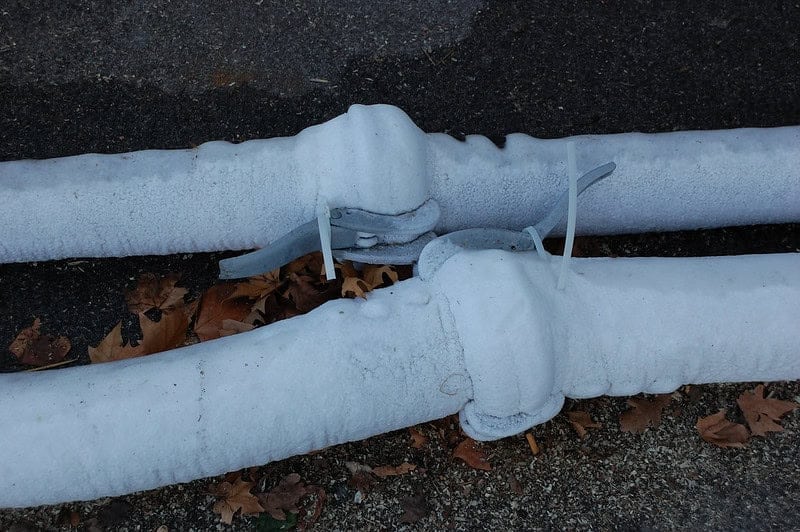
If you can’t locate the frozen section, if multiple fixtures have stopped working at the same time, or if you hear any dripping or trickling behind a wall after the temperature drops, those are all reasons to stop and call rather than experiment. The same goes for any visible bulging, frost, or discoloration on an exposed pipe — those are signs of a pipe that may have already cracked and is being held together by ice pressure alone.
In Cook County, where a polar vortex can push temperatures to -20°F or colder overnight, the window between “frozen but intact” and “frozen and cracked” can be measured in hours. When in doubt, a call costs nothing. A burst pipe costs a great deal more.
Getting the water flowing again feels like the finish line. For us, it’s closer to the halfway point.
After thawing, the pipe needs to be inspected for damage that isn’t immediately visible. Micro-cracks and weakened joints often don’t produce an obvious leak right away — they weep slowly into wall cavities, insulation, or subfloor materials for days or weeks before the water becomes visible. By the time a homeowner notices a stain on the ceiling or a soft spot in the floor, the mold is already growing.
Camera inspection is the tool that closes this gap. Running a camera through the line after thawing shows the actual condition of the pipe interior — not just whether water is flowing, but whether the pipe wall is compromised. It’s the difference between confirming the repair worked and assuming it did. For Cook County homes with older copper, galvanized steel, or cast iron plumbing, this step matters more than it does in newer construction, because aging pipe materials are more susceptible to cracking under freeze pressure and less forgiving of even minor damage.
The other thing that gets skipped in a hurry is winterization. A pipe that froze once is in a location that will freeze again — a basement rim joist, an exterior wall cavity, a crawl space that loses heat faster than the rest of the house. We identify why it froze and recommend a fix — better insulation, heat tape, a pipe reroute — to prevent the same call next February. That’s not an upsell. It’s the actual solution.
Cook County isn’t a generic plumbing market, and frozen pipe repair here comes with a specific set of conditions that matter.
The county’s housing stock skews significantly older than the national average. Chicago bungalows, two-flats, and three-flats — the dominant housing types in neighborhoods like Beverly, Bridgeport, and Avondale — were built in an era when pipe routing through unheated spaces was standard practice. Pipes in these homes run through exterior wall cavities and uninsulated basement rim joists that were never designed to handle sustained sub-zero temperatures. When a polar vortex hits — and Cook County has had several in recent years, including the January 2019 event that pushed Chicago to -23°F with wind chills near -52°F — these homes are the first to feel it.
North Shore communities like Evanston, Skokie, and Wilmette face a compounding factor: lake-effect cold from Lake Michigan drives temperatures down faster and harder than inland areas, meaning exposed pipes in those communities can freeze in conditions that wouldn’t cause problems a few miles west.
In the southwest suburbs — Orland Park, Tinley Park — a different vulnerability pattern shows up in homes built in the 1980s and 1990s. Attached three-car garages in that era often had supply lines running through garage walls that weren’t insulated to modern standards. It’s a specific freeze risk that doesn’t get much attention until it becomes a problem.
We’ve been handling frozen pipe repairs across Cook County for over two decades. That means we arrive at a job already knowing where to look based on the home’s age, location, and construction type. That local experience is part of what makes the repair faster, more accurate, and less likely to miss something that causes a problem down the road.
The core takeaway here is simple: the riskiest part of a frozen pipe situation is usually not the frozen pipe itself — it’s the attempt to fix it without knowing whether it’s already cracked, without the right tools to reach it, and without checking for damage after the water starts flowing again.
A hair dryer on an exposed pipe in a warm basement is a reasonable first step. Open flame, boiling water, or anything that applies heat faster than the pipe can absorb it safely is not. And if you can’t see the frozen section, can’t confirm the pipe is still intact, or have any reason to think the damage has already happened, the right call is to stop and get us on the phone for professional frozen pipe thawing.
If you’re dealing with a frozen pipe in Cook County right now — or you want to get ahead of it before another winter hits — Go-Rooter Emergency Plumbers is available 24 hours a day, every day, with same-day service, upfront pricing before any work begins, and no emergency surcharges when the weather is at its worst. Free quotes are available, and new customers receive $40 off their first service.
Article details:
Share:
Continue learning:
Request a Callback
Want to skip the wait?
Simply enter your contact details, and we’ll call you when a NY Spine Advisor becomes available.