Puddle under your water heater at midnight? Here's how to shut things down, find where the water's coming from, and decide between repair and replacement.
Share:
Request a Callback
Want to skip the wait?
Simply enter your contact details, and we’ll call you when a Go Rooter Advisor becomes available.
Summary:
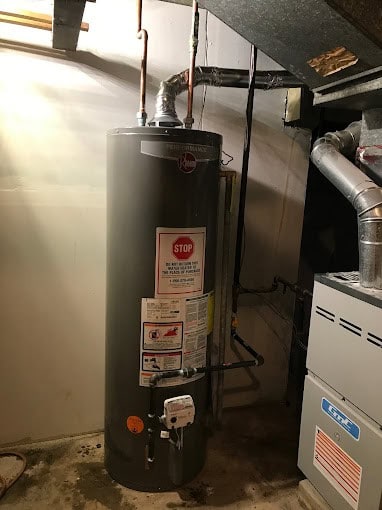
You head down to the basement to switch over a load of laundry, and there’s water spreading out from under the water heater. Your mind goes straight to the worst case. Take a breath. A water heater leaking from the bottom is a common call in Chicago homes, and the cause ranges from a loose valve you can sort out in minutes to a tank that has reached the end of its life. We’ll walk you through what to shut off, how to tell which situation you’re in, and when it makes sense to pick up the phone. First, though, a quick look at what’s going on down there.
Water that shows up at the base of the heater doesn’t always start at the base. A drip from the drain valve, a loose fitting near the top, the pipe attached to the temperature and pressure relief valve, even condensation can all end up as the same puddle on your floor. The one that matters most is the tank itself, because a tank that has corroded through can’t be patched.
In Chicago, the tank deserves a hard look. Lake Michigan water runs about 8 grains per gallon, which is hard by the USGS line of 7, and those minerals settle on the bottom of a tank over the years. That sediment wears on the metal right where your puddle is forming. So let’s start with what to do in the next few minutes, then narrow down the source.
Power first, then water. If your heater is electric, switch off its breaker. If it’s gas, turn the gas control valve on the front of the unit to off or pilot. Then find the cold water shutoff on the pipe coming into the top of the heater and turn the handle until it stops. Turning off the heater alone won’t stop the leak, because the tank keeps refilling from your supply line.
If you smell gas at any point, leave the house and call 911 or your gas utility from outside. Don’t stand in water to reach a breaker panel or a switch. If the floor is wet around anything electrical, leave it alone and call us. We’d much rather talk you through it than have you take a risk.
Once the water is off, dry the base with towels and watch it for five to ten minutes. If the spot stays dry, you may be looking at condensation or a drip from a fitting higher up. If water keeps coming back from underneath, that tells you something different, and we’ll get to it below.
While you wait, take photos of the puddle and the heater, and write down the model and serial number from the label. You’ll want both later. Plenty of Chicago basements have a floor drain or a sump or ejector pump close by, and a leak that reaches them can spread faster than you’d expect. Make sure the drain isn’t backed up and your pump is running. If water is heading for finished space, or you just don’t want to sort out the rest at midnight, we’re here. Go-Rooter Emergency Plumbers answers the phone around the clock, and if you can’t talk, the call-back form on our site works too.
Start low and work up. The drain valve is the spigot near the bottom of the tank, where a garden hose would attach. If it’s dripping from the spout, make sure the handle is fully closed. If it still leaks, the valve itself is worn. Plastic ones commonly give out around the eight to ten year mark, and a fix like that often runs somewhere around $100 to $200 as a general range.
Next, look at the pipe that runs down the side of the tank from the temperature and pressure relief valve. A small, occasional release can happen when pressure swings. A steady drip means something is off, usually high pressure or a tired valve, and it’s worth having checked soon. Also run your hand over the fittings at the top. Water from a loose connection runs down the tank and pools underneath, so it looks like a bottom leak when it isn’t.
Condensation is the false alarm. A cold tank working hard, or a high-efficiency unit, can sweat enough to wet the floor. The dry-and-watch test catches it, since sweat tapers off and a real leak doesn’t.
Then there’s the hard one. If water keeps appearing from under the jacket or along the bottom seam and nothing above explains it, the tank has most likely failed. No sealant or epoxy holds on a corroded tank, so skip that aisle at the hardware store.
Want live answers?
Connect with a Go-Rooter Emergency Plumbers expert for fast, friendly support.
If you are hoping for a cheap fix or bracing for an upsell, you want a straight answer. Here’s how we sort it out. A repair makes sense when the source is a valve, fitting, or gasket, the tank shows no corrosion, and the unit is under roughly six to eight years old with a repair that costs well under half the price of a new heater. That’s a rule of thumb Rheem publishes, and it matches what we’d tell a neighbor. A leaking tank means replacement.
If you own a two-flat or manage a building with tenants in Chicago, add a clock to that. Losing hot water in a Chicago January is a real problem for the people living there, so speed matters as much as the verdict. We’ll tell you what we find, what it will cost, and agree on the price with you before any work starts.
Think of the bottom of your tank as the place where Chicago’s water leaves its mark. At around 8 grains per gallon, the water carries enough minerals to settle as sediment on the tank floor. That layer makes the burner or lower element work harder to heat through it, the metal overheats, and over time it cracks or corrodes. The number shifts a little by neighborhood and suburb across Cook County, IL, so treat 8 as a rough figure, but the pattern holds across the city.
Inside the tank is an anode rod, a piece of metal that’s meant to rust so the tank doesn’t. These typically last about three to five years. Once the rod is used up, the tank itself starts taking the hit.
Winter piles on. Incoming water in Chicago runs roughly 35 to 42 degrees in the coldest months, so your heater runs longer to bring it up to temperature. A polar vortex week tends to be when an older tank finally gives out, and also when you notice because the hot water is gone.
Flushing the tank once a year clears sediment and is worth doing. Just be honest with yourself about what it can’t do. Flushing won’t repair a tank that’s already corroded, and on an old heater it can reveal a leak that was already waiting. If a new heater turns out to be the answer, it’s worth checking water pressure and checking if an expansion tank makes sense before it goes in, since excess pressure can cause leaks at fittings and the relief valve.
Before anyone touches the heater, grab that serial number. The manufacturer can tell the age of the unit from it, and many tanks carry coverage of six years or more, so a heater that fails at five or six may still be covered. Call the warranty line and ask what’s included. Coverage often applies to the tank, but not always to labor or water damage.
Insurance is the second call. The average water heater insurance claim runs about $4,444, with water heaters accounting for roughly 12 percent of residential water damage losses. Your policy may treat a sudden leak differently from a slow one that’s been dripping for weeks, so read it, and hang on to your photos and any written findings from the plumber.
For Chicago homeowners, the timeline matters too. A standard tank swap often takes a matter of hours, depending on the unit and any venting or code work, and we’ll give you a realistic window once we’ve seen the setup. Chicago’s plumbing code governs this work, and a replacement water heater has to be third-party certified with a listing label. That’s one more reason to hire a licensed plumber who knows the city’s rules. We’re licensed, bonded, and insured, and we’ve dealt with the other half of this problem too—fixing ejector pumps after serious basement flooding—so we can look at the water on your floor as well as the heater that put it there.
Here’s the short version. Shut off the power or gas, close the cold supply, dry the base, and watch it. A leak that stops was probably condensation or a fitting. A leak that keeps coming back from underneath usually means the tank is done, and no patch will change that. Take your photos, write down that serial number, and make your warranty and insurance calls.
Call Go-Rooter Emergency Plumbers today at 773-661-4800 to schedule your fast dispatch and expert water heater diagnosis.
Article details:
Share:
Continue learning:
Request a Callback
Want to skip the wait?
Simply enter your contact details, and we’ll call you when a NY Spine Advisor becomes available.