Before you pour another bottle down that basement drain, find out what old cast iron and clay pipes can handle, and when to stop and call.
Share:
Request a Callback
Want to skip the wait?
Simply enter your contact details, and we’ll call you when a Go Rooter Advisor becomes available.
Summary:
You’re standing over a slow basement drain with a bottle of cleaner in your hand, wondering if it’s about to make things worse. Fair question. Every “best drain cleaner” list online ranks products, and almost none of them ask what your pipes are made of or how old they are. In a Chicago two-flat or bungalow, that’s the part that matters most. Plumbers and manufacturers don’t agree on how risky chemical cleaners are, and we’ll lay out both sides plainly. You’ll leave knowing what to try, what to skip, and the point where a phone call is the smarter move than another bottle.
The best drain cleaner is the one that matches your pipe, and sometimes that means no chemical at all. National roundups crown a winner for hair, a winner for grease, a winner for value. That works in a newer house with PVC. It works less well in a Chicago home with cast iron, clay, or galvanized lines that have been carrying water for decades.
In our work across Chicago and North Cook County, IL, we see plenty of homes where nobody knows what’s under the basement floor. When you can’t say what the pipe is or what shape it’s in, any cleaner is a bit of a gamble. Some plumbers call it a bad gamble. Manufacturers call their products safe. Both can be right, depending on the pipe.

Short answer: it depends on the pipe. Drano’s maker says its current formulas are safe for household pipes when used as directed, and that you should never mix it with another cleaner. We tend to be more cautious with older lines. One plumbing and HVAC company says most plumbers recommend skipping chemical openers entirely on pipes older than about 40 years. A plumbing supervisor quoted by AOL points out that cast iron was common in homes built before 1980 and that harsh cleaners can speed up its erosion.
Caustic cleaners give off heat as they work, and over time that can wear on metal pipe. If that’s happening in your house is the one thing nobody can tell from the top of a sink.
That’s the real issue in Chicago. A Lincoln Park greystone might have newer PVC tied into a much older line. A Pilsen basement might have a floor drain connected to pipe nobody has looked at in years. Much of the infrastructure around Chicago is more than 100 years old, and freeze-thaw winters don’t help it any. A fresh hair clog in one bathroom sink is a different story from a slow floor drain in the basement. For the first, a plunger or hand snake is the lower-risk place to start. For the second, keep reading.
Stop pouring. The urge to reach for a stronger bottle is strong, but a second product on top of the first is where things go wrong. Never mix cleaners, and don’t assume a different brand will finish the job the first one couldn’t.
Tell your plumber exactly what you used and roughly when. It sounds like a small detail, but a drain holding caustic liquid is a safety issue for whoever opens it up, and a cable or snake can throw that liquid back at them. A good plumber would rather know up front.
Next, figure out if you’re dealing with one drain or the whole house. A single slow bathroom sink is often a local clog. But if your basement floor drain gurgles when the washer empties, if several fixtures run slow at once, or if you catch a sewage smell, that points to the main line, and no bottle can reach it. The same goes for a drain that clogs again every few months. In Chicago, a floor drain that backs up after heavy rain is its own kind of problem too, and it’s not something a cleaner will fix.
One more thing to rule out: wipes. “Flushable” wipes don’t break down well in older cast iron lines, and one plumber described a two-day clearing job that ended with a dig-up. If that’s in your history, mention it. We won’t judge. We’ll tell you what we find and agree on the price before we start.
Want live answers?
Connect with a Go-Rooter Emergency Plumbers expert for fast, friendly support.
When you call us, we start with what’s happening, not with a sales pitch. Where it makes sense, we run a camera through the line first. That shows us what the pipe is made of, if there’s scale or cracking, and what is causing the blockage. Then we pick the method that fits, picking between rodding, hydro jetting, or something simpler.
We aim to fix the cause, not just clear the symptom, because a drain that clogs again in March doesn’t help anyone. Someone answers the phone at 2am, we offer same-day emergency service, and you agree to the price before work begins. Our homepage lists a 5.0 rating across 90+ Google reviews, and the comments we see most often are about honest explanations and no surprises.

It’s a fair worry, and the answer is the same one we gave about chemicals: it depends on the pipe. Hydro jetting uses high-pressure water to scour a line clean, and it handles grease, roots, and scale well. Some plumbing sources say it’s safe on old pipe when a camera inspection comes first, and that it can clear scale out of cast iron. Others warn that thin or deteriorated pipe can be damaged by high pressure, and that Orangeburg, an older fiber pipe, should never be jetted at all.
That’s why we look before we jet. Jetting a line blind is the same gamble as pouring a bottle down it, just with more pressure behind it. The camera tells us if the pipe can take it. If it can’t, we’ll say so and talk through other options.
Main line rodding is a different tool for a different job. A cable with a cutting head works through the clog mechanically. Both approaches leave no caustic chemical sitting in your pipes afterward. We’ve hydro jetted main city sewer lines for Chicago customers, and sometimes the better long-term answer is flood control or an ejector pump fix rather than another cleaning.
On cost, we currently offer a $55 hydro jetting cleaning coupon and $50 off main line rodding. Coupons can’t be combined, and they’re limited to one per customer. What applies to your line depends on what we find, so ask when you call.
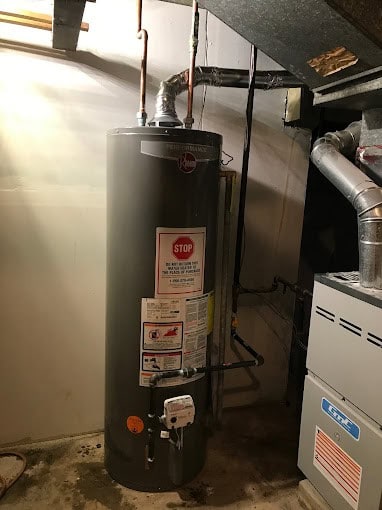
It’s 11pm, and there’s water on the basement floor near the water heater and the floor drain. At that hour, a tank leak and a drain problem look almost identical. Whichever one it turns out to be, the first moves are the same if the heater might be the source. Shut off power at the breaker for an electric unit, or close the gas valve for a gas unit. Then close the cold water supply going into the heater.
Now look closer. Bottom leaks usually come from a worn drain valve, a temperature and pressure relief valve, or a loose connection, and those can sometimes be fixed without replacing the tank. If water is seeping from the tank itself, it’s usually corroded from the inside, often from sediment buildup and a worn-out anode rod. That generally means replacement. Don’t plan on patching a tank that’s leaking through its own body.
A drain problem tells a different story. Water coming up through the floor drain, gurgling, a sewage smell, or water that shows up after the washer runs or after a heavy rain, all while the heater stays dry, points to the drain or the main line. Drain cleaner has nothing to do with a heater leak, but the two can look alike on a wet floor.
If you can’t tell which one you have, call us. We answer 24/7, and we’ll help you work out if the water is coming from the heater or from your drain. If it’s the drain, we can get a camera on it that same day.
The takeaway is simple. The best drain cleaner for an older Chicago home is the one that suits your pipe, and when you don’t know your pipe, a camera is a better first step than a bottle. Try a plunger on a fresh, single-drain clog. Skip the second product if the first one failed. And call us when several drains slow down together, the floor drain gurgles, or the clog keeps coming back.
Call Go-Rooter Emergency Plumbers today at 773-661-4800 to schedule your fast dispatch and expert drain diagnosis.
Article details:
Share:
Continue learning:
Request a Callback
Want to skip the wait?
Simply enter your contact details, and we’ll call you when a NY Spine Advisor becomes available.