Deciding between gas and electric for your water heater replacement? This guide breaks down real costs, labor fees, and what you'll actually pay in Cook County.
Share:
Request a Callback
Want to skip the wait?
Simply enter your contact details, and we’ll call you when a Go Rooter Advisor becomes available.
Summary:
Your water heater just quit. Or maybe it’s making noises that sound expensive. Either way, you’re here because you need answers about replacement costs, and you need them without the runaround.
Here’s what actually matters: gas versus electric pricing, what labor should cost, whether tankless makes sense for your situation, and how to avoid getting hit with surprise fees when you’re already dealing with cold showers. You’ll also see what professional installation covers in Cook County and why that matters more than most homeowners realize.
The price difference between gas and electric isn’t just about the unit itself. It’s about what you’ll pay every month for the next decade.
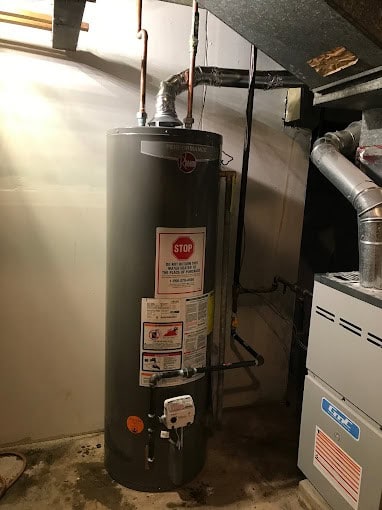
A standard 40-50 gallon gas water heater runs about $1,100-$1,800 installed. Electric models come in slightly cheaper at $1,000-$1,700 for the same size. That $100-$200 difference disappears fast when you look at operating costs.
Gas units cost roughly $30 per month to run. Electric models hit closer to $42 monthly. Over a year, that’s $144 in savings with gas, and over the typical 10-year lifespan, you’re looking at $1,440 in lower utility bills. The upfront savings on electric don’t hold up long-term.
Size matters, but not the way most people think. A bigger tank doesn’t just cost more upfront—it costs more to heat, more to install, and more when it eventually fails.
A 40-gallon gas tank typically runs $1,100-$1,300 installed. Step up to a 50-gallon, and you’re looking at $1,300-$1,500. A 75-gallon unit pushes $1,550-$1,800. Electric models run about $100-$130 less across the board, but remember that monthly operating cost gap.
The real question isn’t which size costs least. It’s which size fits your household without wasting energy. A family of four doesn’t need a 75-gallon tank, and a couple living alone will overpay for years if they install a 50-gallon unit just because “bigger is better.”
Most homes with 2-4 people do fine with a 40-50 gallon tank. Larger families or homes with multiple bathrooms running simultaneously might justify the 75-gallon option. But oversizing costs you twice—once at installation and again every month on your utility bill.
In Cook County, hard water and cold winters already make your water heater work harder than it would in milder climates. Chicago’s brutal cold means your groundwater comes in significantly colder during winter months, forcing your system to use more energy to reach temperature. Sediment from hard water builds up faster here too, reducing efficiency over time.
That’s why professional sizing matters. We evaluate your actual household usage, not just square footage or number of bathrooms. Getting this right the first time saves you from years of overpaying or running out of hot water mid-shower.
Labor isn’t just “installation.” It’s removal of your old unit, disposal, permit handling, code-compliant connections, safety testing, and making sure you’re not going to have problems three months from now.
Standard tank-to-tank replacement labor runs $150-$450 in Cook County. That covers disconnecting your old water heater, hauling it out, installing the new unit in the same location, connecting water lines and gas or electric, and testing everything before leaving.
But here’s where things get expensive fast: if your existing setup isn’t up to current code, you’re looking at additional costs. Older homes often need upgraded gas lines, new venting, electrical panel work, or expansion tank installation to meet Cook County building codes. Those additions can push labor costs up by $500-$2,000 depending on what’s required.
Converting from electric to gas, or vice versa, changes everything. Electric to gas conversion runs $1,500-$2,000 because you need gas line installation and proper venting. Gas to electric is cheaper at $250-$1,000, mainly requiring electrical panel upgrades and circuit work.
Location accessibility affects price too. A water heater in an open basement costs less to replace than one tucked in a tight crawl space or requiring navigation through multiple staircases. Difficult access can add $125-$300 to labor costs.
Permits in Cook County run $25-$300 depending on scope of work. This isn’t optional—Cook County requires plumbing permits for water heater installation and alteration. Skipping the permit might save you $100 today, but it creates serious problems down the line. Unpermitted work can void your homeowner’s insurance, cause failed home inspections when you sell, and result in fines if discovered.
Professional installation also includes things DIY attempts miss: proper venting to prevent carbon monoxide buildup, correctly sized and tested gas connections to avoid leaks, temperature and pressure relief valve installation to prevent explosions, expansion tank installation if required by current code, and warranty protection that DIY work voids.
You’re not just paying for someone to connect pipes. You’re paying for code compliance, safety, and avoiding the kind of mistakes that lead to gas leaks, carbon monoxide poisoning, or insurance claim denials.
Want live answers?
Connect with a Go-Rooter Emergency Plumbers expert for fast, friendly support.
Tankless systems heat water on demand instead of keeping a tank hot 24/7. That efficiency comes with a higher price tag, but for some households, the math works out.
Electric tankless units cost $1,400-$3,000 installed. They’re cheaper than gas tankless models ($2,100-$5,600) because they don’t need venting or gas line work. But they do require serious electrical upgrades in most homes.
Most electric tankless systems need 40-60 amp dedicated circuits. If your electrical panel can’t handle that, you’re looking at panel upgrades costing $850-$1,700 on top of the unit itself. Older homes almost always need this work.
Tankless isn’t automatically better. It’s better for specific situations, and expensive overkill for others.
If you use 41 gallons or less of hot water daily, tankless systems can be 24-34% more energy efficient than tank models. That translates to $100-$200 annual savings on utility bills. For households using more water, efficiency gains drop to 8-14%, which makes the payback period much longer.
Tankless units last 15-20 years compared to 8-12 for tank models. Over two decades, you avoid one full replacement cycle, saving $1,200-$2,500. Combined with energy savings, tankless can pencil out for homeowners planning to stay in their homes long-term.
They also take up significantly less space. A tankless unit mounts on a wall and measures roughly the size of a small suitcase. If your current water heater sits in valuable square footage you’d rather use for storage or living space, that’s worth considering.
But tankless has real drawbacks. The flow rate limitation means you might not be able to run multiple hot water sources simultaneously. If someone’s showering while the dishwasher runs and laundry is going, you could max out the system’s capacity. Larger households often need multiple tankless units or higher-capacity models that push costs even higher.
Installation complexity matters too. Retrofitting a home set up for tank water heaters requires plumbing modifications, possible electrical or gas upgrades, and sometimes structural changes for venting. What looks like a straightforward swap on paper turns into a multi-day project with costs climbing past initial estimates.
For Cook County homeowners, winter performance is another factor. Tankless systems heat water as it flows through, and Chicago’s cold groundwater temperatures mean the unit works harder during winter months. Gas tankless handles this better than electric, but electric is cheaper to install. You’re trading upfront savings for potential performance issues when you need hot water most.
The honest assessment: tankless makes sense for smaller households with moderate hot water use, homeowners planning to stay put for 10+ years, and situations where space is at a premium. For larger families with high simultaneous demand, or homeowners on tighter budgets, standard tank models still deliver better value.
The internet makes water heater installation look simple. Disconnect the old one, connect the new one, done. That’s not remotely close to reality.
Gas water heaters involve combustion, venting, and pressurized fuel lines. One mistake—an improperly sealed gas connection, incorrect vent sizing, or misaligned burner—creates carbon monoxide buildup or gas leaks that can cause explosions. Carbon monoxide is odorless and kills before you realize there’s a problem.
Electric installations require 240-volt wiring. If you’re not experienced with electrical work, you’re dealing with enough current to cause electrocution, house fires, or electrical panel damage. Incorrect wiring also trips breakers repeatedly or causes the heating elements to fail prematurely.
Temperature and pressure relief valves prevent tank explosions. Install one incorrectly or use the wrong discharge tube, and you’re looking at 30-80 gallons of scalding water under extreme pressure. Water heater explosions are rare, but when they happen, they launch tanks through roofs and cause catastrophic property damage.
Permits exist for a reason. Cook County requires them for water heater work, and inspectors check for code compliance. DIY installations almost never get permitted, which creates a paper trail of problems. Your homeowner’s insurance can deny claims for damage caused by unpermitted work. When you sell your home, failed inspections from unpermitted installations delay closing or kill deals entirely.
Manufacturer warranties require professional installation. Do it yourself, and you void coverage. When your $800 water heater fails in year three, you’re buying a new one out of pocket instead of getting warranty replacement.
The cost difference between professional installation and DIY is $300-$500 for labor. That’s not enough savings to justify gas leak risks, fire hazards, voided warranties, insurance problems, and potential resale issues. About 30% of water heater replacements hit complications—corroded shutoff valves, inadequate gas line sizing, venting obstacles, or code violations with existing setup. Professionals handle these on the fly. DIYers usually panic and call emergency plumbers anyway, paying 25-50% more than standard rates.
We handle permits, ensure code compliance, use proper materials and techniques, test all connections for leaks and safety, preserve your warranty coverage, and take on liability if anything goes wrong. You’re not just paying for installation. You’re paying for expertise, safety, and peace of mind that your family isn’t at risk from carbon monoxide, gas leaks, or electrical fires.
Gas versus electric, tank versus tankless, DIY versus professional—these aren’t just technical choices. They’re decisions that affect your monthly budget, your home’s safety, and whether you’re dealing with this again in five years or coasting for the next decade.
Gas units cost more upfront but save $144 annually in operating costs. Electric models are cheaper to install but more expensive to run. Tankless systems offer long-term savings and space benefits but require higher initial investment and work best for smaller households. Professional installation costs $300-$500 more than DIY but protects you from gas leaks, fire hazards, voided warranties, and insurance problems.
For Cook County homeowners dealing with hard water, brutal winters, and strict permit requirements, professional installation isn’t optional. It’s the difference between a system that works safely for years and one that creates expensive problems down the road. We provide upfront pricing, handle all permit requirements, ensure code-compliant installation, and deliver the same-day service you need when your water heater fails.
Article details:
Share:
Continue learning:
Request a Callback
Want to skip the wait?
Simply enter your contact details, and we’ll call you when a NY Spine Advisor becomes available.