A leaking kitchen faucet isn't just annoying—it's wasting water and money every single day. Here's how to know when it's time to call a professional.
Share:
Request a Callback
Want to skip the wait?
Simply enter your contact details, and we’ll call you when a Go Rooter Advisor becomes available.
Summary:
That steady drip from your kitchen faucet might seem minor, but it’s costing you more than you think. A single leaking faucet wastes over 3,000 gallons of water every year, driving up your utility bills month after month. Some leaks can be fixed with basic tools and a trip to the hardware store. Others need professional diagnosis because what looks like a simple drip is actually signaling a bigger problem hiding behind the wall. Knowing the difference saves you from wasting time on repairs that won’t last and helps you avoid the kind of water damage that turns a $150 fix into a $1,500 nightmare. Here’s what you need to know about kitchen faucet leaks and when it makes sense to call someone who does this for a living.
Most kitchen faucet leaks come down to worn-out parts that have reached the end of their useful life. Washers and O-rings are small rubber components that create watertight seals inside your faucet. Over time, they harden, crack, or simply wear down from constant use. When that happens, water finds its way through.
Mineral buildup is another common culprit, especially in Cook County where hard water leaves deposits on everything it touches. Those minerals accumulate on valve seats and cartridges, preventing proper sealing even when the parts themselves aren’t worn out. You might also be dealing with loose connections, damaged cartridges, or water pressure that’s too high for your faucet to handle.
The tricky part is that what you see isn’t always what you’re dealing with. A drip from the spout could mean a bad washer, but it could also mean a corroded valve seat or a cartridge that’s failing. A leak around the base might be a loose connection you can tighten in five minutes, or it could be a cracked pipe inside the wall that’s been slowly soaking your cabinets for weeks.
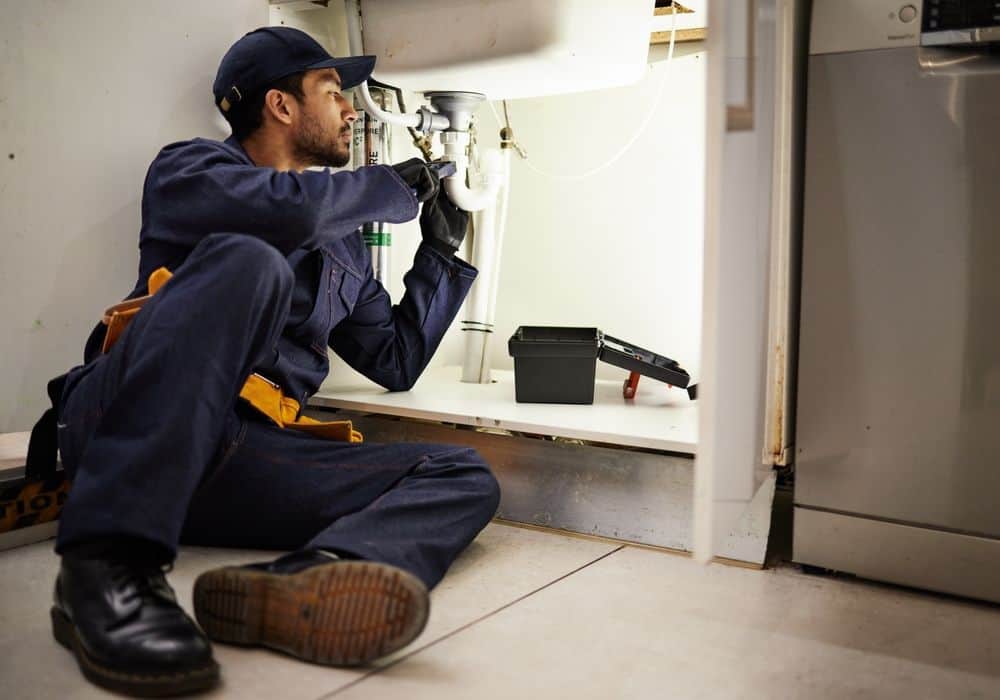
Not every leak stays contained to the visible parts of your faucet. Water has a way of finding paths you didn’t know existed, and by the time you notice puddles under the sink or water stains on the cabinet, the damage has often been building for a while.
Leaks around the base of the faucet can seep into countertops, especially if you have laminate or wood. That moisture causes swelling, warping, and eventually rot that weakens the entire structure. Water that drips underneath travels into cabinets, soaking particle board and creating the perfect environment for mold growth. You might not see it until you open that cabinet and find black spots spreading across the back wall.
In older Chicago homes, the issue gets more complicated. Many properties still have original plumbing with galvanized pipes that corrode from the inside out. A faucet leak might actually be the first visible sign that your supply lines are failing. What starts as a minor drip can suddenly become a burst pipe when the weakened section finally gives way.
The cost difference matters too. Fixing a leaky faucet runs $75 to $175 in the Chicago area for straightforward repairs. Replacing water-damaged cabinets, treating mold, and repairing structural damage from prolonged leaks? That’s easily $1,500 to $5,000 or more. The longer you wait, the more expensive the problem becomes.
Winter adds another layer of risk for Cook County homeowners. If you have any outdoor faucets or pipes in unheated areas, even a small leak can freeze when temperatures drop. Water expands by 9% when it freezes, creating enough pressure to crack pipes and fittings. You won’t notice until spring when everything thaws and water starts pouring through the new cracks.
That slow drip doesn’t seem like much when you’re standing there watching it. One drop every few seconds barely registers. But those drops add up faster than you’d expect.
According to the EPA, a faucet that leaks at a rate of one drip per second wastes more than 3,000 gallons of water in a year. That’s enough to fill a backyard swimming pool. If your leak is faster—say 10 drips per minute—you’re looking at 5 gallons wasted every single day. Two slow-dripping faucets in your home can waste 10,000 gallons annually, which is roughly what a family of four uses in an entire month.
The average household in the U.S. already wastes about 10,000 gallons per year from various leaks. Ten percent of homes waste more than 90 gallons daily. Most of that waste comes from faucets and toilets that people know are leaking but haven’t gotten around to fixing yet.
Your water bill reflects this waste directly. Even a minor leak can increase your bill by 10% or more. In Cook County, where water and sewer rates continue climbing, that percentage translates to real money every month. A leak that costs you an extra $15 per month adds up to $180 per year—more than the cost of having it fixed professionally.
Beyond your own costs, there’s the environmental impact. Wasting thousands of gallons puts unnecessary strain on local water systems, especially during dry periods when conservation matters most. Fixing leaks is one of the simplest ways to reduce your household’s water footprint.
The math is straightforward: the sooner you stop the leak, the sooner you stop wasting water and money. Every day you delay is another day of waste you’re paying for.
Want live answers?
Connect with a Go-Rooter Emergency Plumbers expert for fast, friendly support.
Some faucet repairs are genuinely simple. If you’re comfortable with basic tools and can follow step-by-step instructions, you might be able to handle certain fixes yourself. Cleaning a clogged aerator takes five minutes and requires nothing more than unscrewing the screen at the end of your spout. Tightening a loose handle or connection can sometimes stop a leak without any parts replacement.
Replacing a worn washer or O-ring is doable for many homeowners, though it requires shutting off the water, disassembling the faucet, and making sure you get the exact right replacement part. If you’re willing to invest the time and you’re confident you can put everything back together correctly, it’s worth trying.
But there’s a line where DIY stops making sense. If you’ve already tried replacing parts and the leak comes back, something else is wrong. If you see multiple leaks throughout your house, that points to a systemic issue like water pressure problems or aging plumbing. If the leak is coming from inside the wall or you can’t figure out where the water is actually coming from, you need someone with diagnostic tools and experience.

Outdoor faucets face challenges that indoor fixtures don’t, and in Cook County’s climate, winter freeze damage is the biggest threat. Even if you thought you winterized properly, a hose left attached or water trapped in the line can freeze and crack the faucet or the pipe behind it.
The problem with freeze damage is that you often don’t know it happened until spring. While everything is frozen solid, the crack is sealed by ice. Once temperatures rise and the ice melts, water starts flowing through the new opening. You turn on your outdoor faucet for the first time in months and discover it’s leaking from places it shouldn’t, or worse, water is running inside your basement wall.
Frost-free faucets are designed to prevent this by keeping the shut-off valve inside the warm part of your house, but they only work if they’re installed correctly and if you disconnect hoses before winter. If a hose blocks the spout, water can’t drain from the exterior section, and that trapped water will freeze and cause damage.
Repairing an outdoor faucet that’s been damaged by freezing isn’t always straightforward. Sometimes the faucet itself is fine but the supply pipe behind it has cracked. Other times the valve seat is corroded or the washer is shot. You might need to replace the entire faucet, or you might need to access the pipe inside the wall to fix a crack you can’t see.
If your outdoor faucet starts leaking after a hard freeze, don’t assume it’s just a washer. Get it checked before you turn it on repeatedly and flood your basement or foundation. We can inspect the entire assembly, identify freeze damage, and make repairs that will actually hold up through the next winter.
Bathroom faucets leak for the same basic reasons as kitchen faucets—worn washers, damaged O-rings, corroded valve seats, and failing cartridges. But bathroom faucets often have different configurations that affect how you approach repairs.
Widespread faucets with separate hot and cold handles require you to figure out which side is leaking before you start taking things apart. You can test this by shutting off one supply line at a time under the sink and seeing if the drip stops. Single-handle faucets usually have a cartridge under the handle that controls both temperature and flow. When that cartridge wears out, you get leaks from the spout or around the base.
Leaks around the base of a bathroom faucet often mean the seal between the faucet and the sink has failed. Water runs down the faucet body during use and pools on the counter. This can happen from loose mounting nuts or degraded caulk, but it can also indicate that the faucet itself is cracked or that internal seals have failed.
Bathroom sink faucets tend to cost less to repair than kitchen faucets because they’re generally simpler and have fewer moving parts. But that doesn’t mean every bathroom leak is a quick fix. If your faucet is more than 15 years old, replacement parts might be hard to find. If the finish is corroded or the faucet body is cracked, you’re looking at full replacement rather than repair.
One thing to watch for in bathrooms is mineral buildup from hard water. Chicago-area water is notoriously hard, and those minerals accumulate quickly on faucet aerators, valve seats, and cartridges. Regular cleaning with vinegar can extend the life of your faucet parts, but once corrosion sets in, cleaning won’t fix it.
If you’re dealing with a bathroom faucet that leaks intermittently or only at certain times, water pressure fluctuations might be forcing water past seals that are barely holding on. That’s not something you can fix with a new washer—you need to address the pressure issue or upgrade to a faucet designed to handle higher pressure.
A leaking faucet isn’t something you have to live with, and it’s not something you should ignore. Whether it’s a slow drip from your kitchen sink, an outdoor faucet that started leaking after winter, or a bathroom faucet that’s been getting worse for months, fixing it now saves you money, water, and the hassle of dealing with bigger problems down the road.
Some repairs are simple enough to tackle yourself if you have the time and the right parts. Others need professional diagnosis because what looks like a minor issue is actually a symptom of something more serious. The key is knowing which is which and being honest about whether a DIY fix is going to hold or just delay the inevitable.
If you’re in Cook County and you’re dealing with a faucet leak that won’t quit, we can diagnose the real problem and fix it with solutions that last. No surprise charges, no quick patches that fail in a month, just straightforward repairs from people who do this work every day.
Article details:
Share:
Continue learning:
Request a Callback
Want to skip the wait?
Simply enter your contact details, and we’ll call you when a NY Spine Advisor becomes available.