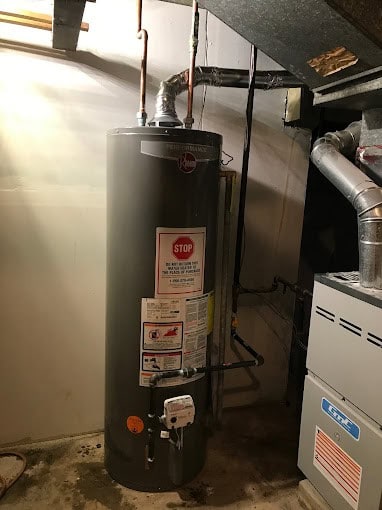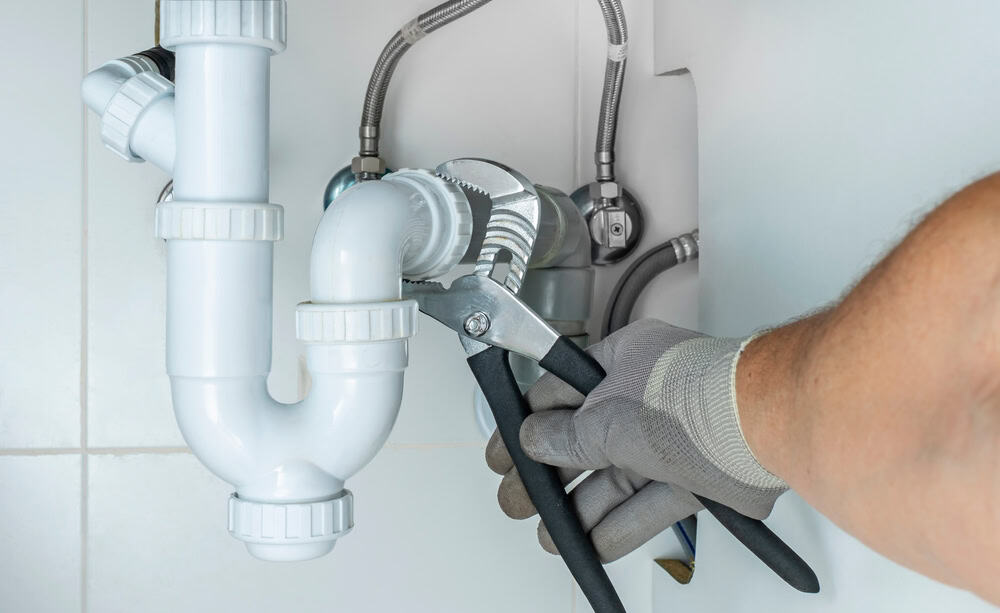
Not sure whether to replace your water heater with a tankless unit or stick with a traditional tank? Here's what Cook County homeowners actually need to know.
Share:
Request a Callback
Want to skip the wait?
Simply enter your contact details, and we’ll call you when a Go Rooter Advisor becomes available.
Summary:
Your water heater doesn’t usually give much warning. One morning there’s no hot water, or you spot a puddle forming around the base of the tank, and suddenly you’re making decisions you weren’t planning to make today. The first question most people ask is: how much is this going to cost? The second is usually: should I just go tankless this time?
Both are fair questions. The answers depend on your home, your household size, and — if you’re in Cook County — some local factors that a lot of generic cost guides completely ignore. Here’s what you actually need to know.
Nationally, a standard tank water heater replacement runs somewhere between $882 and $1,817, with most homeowners landing around $1,339. In Cook County, expect to pay closer to $1,700 to $2,500 for a 50-gallon gas unit — and that’s for a straightforward like-for-like swap with no infrastructure surprises.
The gap between national averages and Cook County pricing comes down to a few things: licensed labor rates in the Chicago area, permit requirements, and the age of the housing stock. A lot of homes here — bungalows, two-flats, pre-war greystones — were built before modern plumbing codes existed. That means what looks like a simple replacement sometimes isn’t.

The unit is only part of what you’re paying for. When you get a quote for water heater replacement, the number you see should include labor, permit fees, disposal of the old unit, and any code-required upgrades — but not every contractor includes all of those by default. That’s where quotes that look cheap on paper end up costing more in the end.
Permit fees in Cook County typically run $75 to $150 for a standard residential replacement. The City of Chicago has an Easy Permit Program that handles straightforward swaps and can be approved same-day, which is helpful when you’re dealing with an urgent situation. But the permit still needs to be pulled — and in Cook County, that’s not optional. An unpermitted installation can void your manufacturer’s warranty, create complications with your homeowner’s insurance, and become a real problem if you ever sell the home.
Then there’s venting. Older homes in Chicago’s bungalow belt frequently have single-wall or B-vent flue pipes that don’t meet current code for modern high-efficiency units. Upgrading the venting on a pre-1980 home typically adds $200 to $800 to the job. If the gas line needs to be resized — which is more common than most people expect — that’s another $400 to $1,200 depending on the run length and what’s already in the wall.
None of this means your replacement will hit the high end of those ranges. Many jobs in Cook County are clean, straightforward swaps. But if someone quotes you a number that seems surprisingly low, it’s worth asking exactly what’s included — because the things that get left out of low quotes tend to be the things that are legally required.
A traditional tank water heater is generally rated for 8 to 12 years. In Cook County, that lifespan can skew toward the shorter end — and it’s not a coincidence. Chicago’s municipal water supply runs moderately hard, which accelerates sediment buildup inside the tank. Over time, that sediment acts as insulation between the burner and the water, forcing the unit to work harder and wear out faster. Annual flushing helps, but most homeowners don’t do it consistently, and the damage accumulates quietly.
The climate compounds the problem. Chicago averages around 105 days below freezing each year. In January and February, incoming groundwater can drop to 35 or 40 degrees Fahrenheit — compared to 55 or 60 degrees in summer. That means your water heater is working significantly harder in winter just to reach the same output. Units that are already aging don’t always survive the added strain, which is why water heater failures spike during the coldest stretches of the year.
If your unit is approaching the 8-year mark and you’ve noticed inconsistent water temperature, rumbling sounds during heating cycles, or rust-colored water at the tap, those aren’t signs to wait on. In this climate, with this water, a unit showing those symptoms is telling you something. The question at that point isn’t really whether to replace it — it’s what to replace it with.
Want live answers?
Connect with a Go-Rooter Emergency Plumbers expert for fast, friendly support.
Tankless water heaters heat water on demand instead of storing it in a tank. No standby heat loss, no 50-gallon reservoir sitting in your basement cycling on and off all day. The appeal is real — longer lifespan, lower operating costs, and hot water that doesn’t run out mid-shower. But converting from a traditional tank to a tankless system is not a drop-in replacement, and the upfront cost reflects that.
A whole-house gas tankless system in Cook County typically runs $2,500 to $5,500 installed, depending on the unit and what infrastructure work your home needs. That’s a meaningful jump from a tank replacement, and it’s the number that makes most people pause. The long-term math, though, tells a different story.
The installation process for a tankless conversion is more involved than a standard tank swap, and it helps to understand why before you commit to the project. A tankless unit requires a significantly higher gas flow rate than a traditional tank — meaning the existing gas line may need to be upsized to handle the demand. In older Cook County homes, this is a common requirement, not an edge case. Gas line upgrades typically add $400 to $1,200 to the project, depending on how far the line runs and what diameter it currently is.
Venting is another factor. Tankless units use different venting configurations than traditional tanks, and the old flue pipe almost never carries over. Direct-vent or power-vent systems require new dedicated venting, which adds $100 to $600 in most cases — more if the installation is in a tight space or the run is long, which is a reality in many Chicago bungalows and two-flats where mechanical rooms weren’t designed with modern equipment in mind.
If you’re considering an electric tankless unit rather than gas, the electrical infrastructure requirements are substantial. Most homes will need a dedicated circuit, and many will need a panel upgrade — that alone can run $850 to $1,700 or more. For most Cook County homeowners with existing gas service, a gas tankless system is the more practical and cost-effective path.
The installation itself typically takes 4 to 10 hours for a conversion, compared to 2 to 4 hours for a like-for-like tank swap. When all the infrastructure work is done correctly, a tankless unit can last 15 to 20 years, compared to 8 to 12 for a traditional tank. Over a 20-year period, gas tankless systems generally save Cook County homeowners $3,770 to $10,000 compared to traditional tanks when you factor in lower annual operating costs.
Labor is one of the more variable parts of a tankless installation quote, and it’s worth understanding what drives it. In Cook County, where licensed plumbers typically charge $45 to $200 per hour for standard work — and significantly more for emergency calls — the labor portion of a tankless conversion can be substantial, especially if the job involves gas line work, new venting, or difficult access.
What makes the labor cost higher for a conversion versus a straight tank swap is the number of systems being touched. A licensed plumber pulling this job may be working on the gas line, the venting, the water supply connections, and the unit itself — each of which has its own code requirements and inspection points. In Illinois, all of this work must be performed by a plumber licensed under 225 ILCS 320, the Illinois Plumbing License Law. That’s not a formality — it’s a legal requirement, and it’s also your protection. Licensed plumbers carry $1,000,000 in liability insurance in Cook County and have completed a minimum four-year apprenticeship plus ongoing continuing education. That background matters when someone is working on your gas line.
One thing that catches homeowners off guard is the difference between what a quote includes and what the final invoice reflects. Some contractors price the unit and basic labor, then add infrastructure work as it’s discovered on-site. That’s how a $2,800 quote becomes a $4,200 invoice. When we give you a price at Go-Rooter, it’s the price — you know the full number before we start, including any required upgrades.
If your water heater is under eight years old and the issue is isolated — a faulty thermostat, a worn heating element — repair often makes sense. But if the tank is leaking from the bottom, if it’s past the decade mark, or if you’re seeing the signs of hard water wear and winter stress, replacement is usually the smarter move. The only question left is which direction to go.
For most Cook County homeowners with existing gas service, a tankless system makes strong long-term sense — but only when the full infrastructure picture is accounted for upfront. A conversion done right, with properly sized gas lines, correct venting, and a permit on file, will serve you well for 20 years. A conversion done cheap, without those pieces in place, creates problems that show up later at the worst possible time.
If you’re trying to figure out what makes sense for your specific home — whether that’s a bungalow on the North Side, a two-flat in Cicero, or a house in Evanston with a mechanical room that’s seen better days — we’re available 24/7 to walk you through it. We’ll tell you what the job actually involves and what it will cost before anything gets started.
Article details:
Share:
Continue learning:
Request a Callback
Want to skip the wait?
Simply enter your contact details, and we’ll call you when a NY Spine Advisor becomes available.