When your water heater fails, the first 30 minutes matter most. Here's how to stay safe, limit damage, and know when to call a plumber.
Share:
Request a Callback
Want to skip the wait?
Simply enter your contact details, and we’ll call you when a Go Rooter Advisor becomes available.
Summary:
Your water heater doesn’t care that it’s a Saturday night, that you have guests coming tomorrow, or that the temperature outside has been in the single digits all week. When it fails, it fails — and the first thing most people feel is a combination of panic and confusion. Is this dangerous? Do I need to leave? Can it wait until morning? Should I try to fix it myself?
Those are exactly the right questions. And the answers depend on what’s actually happening — not just that the hot water is gone. Here’s how to work through the first 30 minutes of a water heater emergency the right way.
The most important thing you can do in the first few minutes is assess, not act. Before you touch anything, look and listen. Is there water on the floor? Can you smell gas? Is the T&P valve — that’s the temperature and pressure relief valve on the side of the tank — hissing or dripping? Each of those tells you something different about how serious the situation is.
If you smell gas, stop. Don’t flip any switches, don’t use your phone inside the house, and get everyone out. Call your gas provider and 911 from outside. A gas leak near a water heater is a genuine emergency that goes beyond plumbing — it’s a safety situation, and no repair call is worth making before you’ve cleared the building.
If there’s no gas smell and no active flooding, you have a few minutes to work through the shutdown steps deliberately. That’s where most homeowners in Cook County can actually make a difference before a plumber arrives.
Shutting down the unit correctly is the single most useful thing you can do in the first ten minutes. It stops the situation from getting worse and makes the repair process faster once a technician arrives.
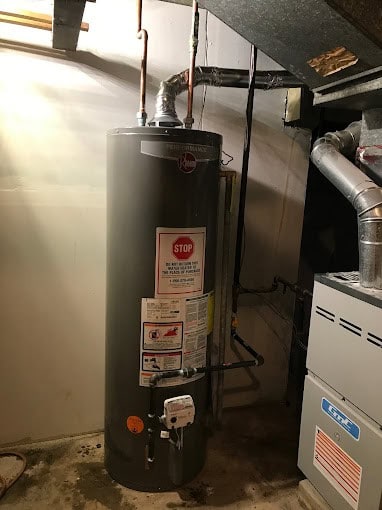
For a gas water heater, find the gas control valve — it’s typically located near the bottom of the unit, on the gas supply line. Turn it to the “off” or “pilot” position. You’re not shutting off the main gas supply to your house, just cutting the flow to the heater itself. Next, find the cold water supply inlet at the top of the tank (it’s usually the line on the right side) and turn the shutoff valve clockwise until it stops. If the tank is leaking, this prevents more water from entering and adding to the problem.
For an electric water heater, go to your circuit breaker panel and flip the breaker for the water heater to the off position. This is critical — water and live electrical components are a serious hazard, and you don’t want to be reaching around a leaking tank with the unit still powered. Once the breaker is off, shut off the cold water inlet the same way you would for a gas unit.
After you’ve cut power or gas and stopped the water supply, resist the urge to drain the tank yourself unless there’s active flooding and you’re confident in what you’re doing. A full 40- or 50-gallon tank holds a lot of hot water, and draining it incorrectly can cause burns or make the repair more complicated. If you need to drain it to prevent floor damage, attach a garden hose to the drain valve at the bottom of the tank and run it to a floor drain or outside — but open a hot water faucet somewhere in the house first to let air in, or the tank won’t drain properly.
Before the plumber arrives, take a few photos of the tank, the area around it, and any visible damage. If there’s water on the floor, document it. This matters for insurance purposes and helps the technician assess the situation faster when they walk in.
Not every water heater failure is a drop-everything situation — and knowing the difference can save you a lot of stress. The challenge is that most homeowners have no frame of reference for what’s actually dangerous versus what’s just inconvenient.
There are three categories: evacuate now, call immediately, and call in the morning.
Evacuate now applies when you smell gas, when the T&P valve is actively discharging steam or water continuously (not just a brief drip), or when you see signs of carbon monoxide exposure — headache, dizziness, nausea that clears up when you go outside. These are not plumbing problems. They’re safety emergencies. Get out, call 911 and your gas provider, and let the professionals handle it from a safe distance.
Call immediately covers situations where there’s active water on the floor that isn’t stopping, where the tank is visibly bulging or making a loud rumbling or banging sound under pressure, or where you’ve shut things down but there’s already significant water damage spreading to flooring, drywall, or adjacent rooms. Every minute of active leaking compounds the damage. In a Cook County winter, a water heater that’s been working overtime for months to keep up with the cold is more likely to fail suddenly and more likely to fail completely — so when it goes, it often goes fast.
Call in the morning is appropriate when the hot water is simply gone — no leak, no smell, no strange sounds — and you’ve checked the obvious culprits. For electric heaters, a tripped breaker is the first thing to check. For gas heaters, a pilot light that went out is common and can sometimes be relit following the instructions on the unit’s label. If those quick checks don’t resolve it, the issue is internal — a failed heating element, a faulty thermostat, a dead thermocouple — and it needs a professional diagnosis, but it’s not a flood-the-floor emergency.
The honest truth is that a lot of homeowners call too late, not too early. A small leak that seems manageable at midnight can destroy a subfloor by morning. When in doubt, call.
Want live answers?
Connect with a Go-Rooter Emergency Plumbers expert for fast, friendly support.
Once the immediate situation is under control, the next question most homeowners face is whether to repair the unit or replace it entirely. It’s a fair question, and the honest answer depends on a few specific factors — not a blanket rule.
The most useful benchmark in the industry is what’s sometimes called the 50% rule: if the cost of the repair exceeds 50% of what it would cost to replace the unit, replacement is usually the smarter long-term call. But that rule only works if you know both numbers — which is why an upfront diagnosis matters before you commit to anything.
Repair is almost always the right answer when the unit is relatively young and the problem is isolated to a single component. A failed thermocouple on a four-year-old gas water heater, for example, is a straightforward fix. A burned-out heating element on an electric unit that’s only six years old is the same story. These are wear parts — they fail, they get replaced, and the unit runs fine for years afterward.
The math matters here. Typical water heater repairs run between $200 and $600 depending on what’s failed and the complexity of the fix. A full replacement, by contrast, runs $1,500 to $2,500 for most residential units. If you’re looking at a $250 repair on a unit that’s seven years old with no history of problems, repair is the clear choice.
Where it gets more complicated is when the unit is older — generally past the 10-year mark for a tank-style heater — and the repair needed is significant. At that point, you’re spending real money to extend the life of a unit that’s statistically likely to fail again within a few years. Manufacturers generally recommend replacement after 10 to 12 years for gas tank heaters and 10 to 15 years for electric, regardless of how the unit looks on the outside. The internal components, including the anode rod and the tank lining itself, degrade over time in ways that aren’t always visible.
Cook County’s water supply, which comes from Lake Michigan, adds another layer to this consideration. Municipal treatment processes still leave minerals in the water that gradually build up as sediment inside the tank over time. That sediment acts as an insulating layer between the heating element and the water, forcing the unit to run hotter and longer to hit the set temperature. Over years, that accelerates wear on every component. If your unit has never been flushed — and most haven’t — it may be aging faster than its calendar age suggests.
If replacement is the right call, the process in Cook County involves a few steps that homeowners sometimes don’t anticipate — and skipping any of them creates real problems down the line.
First, all water heater installation work in Illinois requires a licensed plumber. This is state law under the Illinois Plumbing License Law (225 ILCS 320), and it applies to both new installations and replacements. In Chicago specifically, the requirements go further: the plumber must hold a current City of Chicago plumber license, and a permit must be pulled for the work. Homeowners cannot self-pull permits for water heater work in Chicago — it has to go through a licensed contractor. In the suburban Cook County municipalities, the permit requirements vary by jurisdiction but are similarly enforced.
This matters for more than regulatory compliance. If a water heater is installed without the required permit, it can create complications with your homeowner’s insurance, create disclosure obligations when you sell the property, and leave you without recourse if the installation causes a problem. An unlicensed installation that causes a flood or a gas leak is a very bad place to be from an insurance standpoint.
On the unit itself: if you’re replacing a traditional tank heater, it’s worth having a real conversation about whether a tankless unit makes sense for your household. Tankless heaters last 20 or more years compared to the 8 to 12 years of a tank unit, and they’re 24 to 34% more energy efficient. The upfront cost is higher, but for a household that plans to stay in the home long-term, the math often works out. For Cook County homeowners dealing with severe winters, the efficiency gains are especially meaningful — your water heater works harder here than it would in a warmer climate, and a more efficient unit translates directly to lower utility bills over the life of the system.
We use camera inspections as part of our diagnostic process — not just to assess the water heater itself, but to check for related issues in the supply lines and surrounding plumbing that could affect the new installation. In older Cook County homes, where original plumbing infrastructure is common, this step frequently surfaces problems that would otherwise become the next emergency.
A water heater emergency is one of those situations where the first 30 minutes genuinely matter. Shutting things down correctly, reading the situation accurately, and getting the right help fast can be the difference between a $300 repair and a $3,000 water damage claim.
Cook County winters don’t leave a lot of margin for error. When your water heater is working harder than heaters in warmer markets just to keep up with the cold, failures tend to be fast and complete — not gradual and forgiving. The best time to act is before you’re standing in a puddle at midnight. The second-best time is right now.
If you’re dealing with a water heater emergency — or you’re not sure whether what you’re seeing qualifies as one — we’re available 24 hours a day, seven days a week, with no after-hours surcharges and upfront pricing before any work begins. We serve all of Cook County, and we typically arrive within an hour of your call. New customers receive $40 off, and we offer a 10% senior discount on residential plumbing under $2,500. Give us a call — we’ll tell you exactly what’s going on and what it will cost before we do anything.
—
Article details:
Share:
Continue learning:
Request a Callback
Want to skip the wait?
Simply enter your contact details, and we’ll call you when a NY Spine Advisor becomes available.