Not sure whether to go tankless or stick with a tank? Here's what Chicago homeowners actually need to know before making the call.
Share:
Request a Callback
Want to skip the wait?
Simply enter your contact details, and we’ll call you when a Go Rooter Advisor becomes available.
Summary:
If your water heater just died — or you’ve been watching it limp along for the past two winters — you’re probably wondering whether this is the moment to finally go tankless. It’s a fair question. The answer depends a lot on your house, your household, and how long you plan to stay.
Generic comparison articles won’t tell you that. They also won’t tell you what happens when a plumber opens up the walls of a pre-war Chicago bungalow and finds a gas line that was never meant to feed a modern tankless unit. That’s the part worth understanding before you decide.
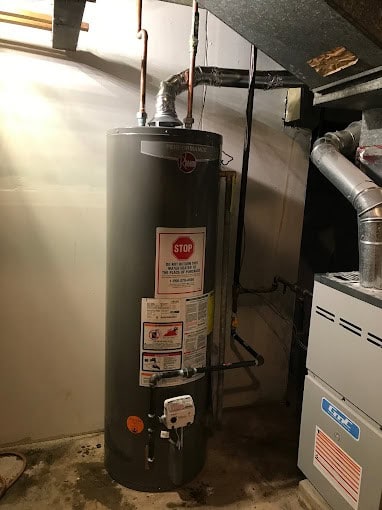
A traditional tank water heater is exactly what it sounds like. It holds 40 to 50 gallons of water, keeps it hot around the clock, and delivers it whenever you turn on the tap. Simple, reliable, and familiar.
The trade-off is that it’s constantly burning gas (or electricity) to maintain that temperature — even at 2 AM when no one’s showering.
A tankless unit heats water on demand. When you turn on the hot water, cold water flows through the unit, gets heated instantly, and comes out the other end. No tank, no standby heat loss, no 50-gallon reservoir waiting to spring a leak.
The appeal is real. But so are the installation requirements — especially in older homes throughout Cook County.

The efficiency argument for tankless is legitimate. The U.S. Department of Energy puts the energy savings at 24 to 34 percent for homes using 41 gallons or less of hot water per day. Over time, that adds up.
Tankless units also last significantly longer — 20-plus years compared to the 10 to 15 years you’d typically get from a tank unit, particularly in Cook County’s hard water environment, where calcium and magnesium buildup accelerates wear on both systems.
The space savings are real too. A wall-mounted tankless unit frees up a meaningful footprint in a basement or utility closet, which matters in the dense two-flats and courtyard buildings that define so much of Chicago’s residential stock.
But here’s what those efficiency numbers don’t tell you. A conventional 40-gallon tank water heater runs at roughly 30,000 to 40,000 BTU per hour. A whole-home gas tankless unit demands 150,000 to 200,000 BTU per hour. That’s not a minor upgrade — that’s a completely different infrastructure requirement.
Most older Chicago homes have half-inch gas lines that simply cannot deliver that volume. Upgrading to three-quarter inch or larger runs $500 to $1,500 on its own.
Then there’s venting. Your existing B-vent chimney — the one your current tank water heater uses — is not code-compliant for a tankless exhaust. Tankless units require direct venting to the exterior through specific materials. Add another $300 to $1,500 for that modification.
If you’re in a home with a 100-amp electrical panel, you may need an upgrade there too before the installation is complete.
One more thing worth knowing: tankless units are not truly maintenance-free. In a hard water market like Cook County — where Lake Michigan water carries enough calcium and magnesium to accelerate scale buildup — tankless heat exchangers need annual descaling. Skip that maintenance and you’ll shorten the unit’s lifespan considerably.
This is the part most plumbing content skips. So let’s be direct: for a lot of Cook County homeowners, a high-quality tank water heater is the smarter financial choice.
If your home was built before 1970 — and in Chicago, that describes a lot of bungalows, two-flats, and courtyard apartments — the infrastructure upgrades required to support a tankless unit can add $1,500 to $3,000 on top of the installation cost. A tankless unit installed in Cook County runs $5,500 to $8,500 fully installed. A quality tank replacement runs $2,000 to $5,000 depending on the unit and venting configuration.
When you’re looking at a $3,000-plus gap in upfront cost, plus several thousand dollars in infrastructure work, the math on energy savings takes a long time to work out. The payback period on a tankless unit can range from 12 to 27 years depending on your usage and what upgrades your home needs.
If you’re planning to move within the next five to seven years, the calculus shifts even further. You may recoup some of that investment in resale value, but you won’t recoup it in energy savings.
On the other hand, if your home already has the gas capacity and venting infrastructure to support tankless — or if you’re doing a larger renovation that includes those upgrades anyway — the long-term case for tankless gets a lot stronger. Larger households with high simultaneous hot water demand also benefit more, since tankless units can deliver 8 to 10 gallons per minute, enough to run two showers and a dishwasher at the same time.
The honest answer is that neither system is universally better. What matters is your house, your usage, and your timeline.
Want live answers?
Connect with a Go-Rooter Emergency Plumbers expert for fast, friendly support.
Energy efficiency ratings look straightforward on paper. In practice, they’re calculated under conditions that don’t always reflect what your water heater is actually doing in a Chicago January.
Chicago’s incoming groundwater temperature drops to around 35 to 40 degrees Fahrenheit in winter. That’s significantly colder than the national averages used in most efficiency calculations. Your water heater — whether tank or tankless — has to work harder here than it would in a warmer climate.
Tankless units in particular need to be sized for that cold-climate reality. An undersized tankless unit will struggle to maintain adequate flow rates during peak winter demand in Cook County.
The question isn’t really “which type is better.” It’s “which type is right for this house, this household, and this budget.”
Start with your home’s age and infrastructure. If you’re in a pre-1970 Chicago bungalow or two-flat, the first question is whether your gas line and venting can support a tankless unit without major upgrades. That’s not something you can determine from a spec sheet — it requires someone who actually knows what they’re looking at inside an older Cook County home.
We use camera inspections and thorough assessments before recommending anything, because the last thing anyone needs is to discover mid-project that the gas line needs to be replaced.
Next, think about your household’s hot water usage. A couple with low simultaneous demand is a very different situation from a family of five running back-to-back morning showers. Tankless units shine when demand is either very high (large household, high flow rate) or very low (small household, significant energy savings).
Finally, consider your timeline. Tankless makes the most financial sense for homeowners who plan to stay in the home long enough to recoup the upfront cost difference through energy savings. If you’re planning a renovation, a move, or a major infrastructure update anyway, that changes the math. And if your water heater just failed and you need hot water today, a tank-to-tank replacement can typically be completed in two to four hours. A tankless conversion is a full-day project, sometimes longer, once you account for the infrastructure work.
Chicago’s housing stock is one of the most distinctive in the country. The bungalow belt — those brick single-family homes built primarily between 1910 and 1940 — stretches across dozens of neighborhoods and represents one of the most common residential building types in the city.
Add in the two-flats, three-flats, and courtyard apartment buildings that define so much of Cook County’s urban fabric, and you’re looking at a market where the majority of homes were built for plumbing infrastructure that is now 60 to 100 years old.
That matters enormously for tankless water heater decisions. These homes were not designed with 150,000 to 200,000 BTU gas demand in mind. Their half-inch gas lines, their B-vent chimneys, and in many cases their 100-amp electrical panels are all sized for a world that predates modern tankless technology.
Retrofitting tankless into these homes isn’t impossible — we do it regularly — but it requires a thorough assessment upfront and honest communication about what the project actually involves.
What that typically looks like: we assess your existing gas line capacity, your venting configuration, your panel, and your hot water demand before recommending a system. If upgrades are needed, they should be identified and priced before any work begins — not discovered mid-project. That’s how we approach every water heater installation, because surprises are expensive and avoidable.
There’s also a common misconception worth clearing up: tankless water heaters do not deliver truly instant hot water. There’s still a delay while the cold water sitting in the pipes gets purged. A recirculation pump can address this, but it adds to the cost. If instant hot water at the tap is a priority, that’s worth factoring into the conversation before you commit.
For homeowners in Lincoln Park, Oak Park, Evanston, Berwyn, or any of the older neighborhoods throughout Cook County, these infrastructure questions are not hypothetical. They’re the reason a professional assessment matters more than an online comparison chart.
The tankless vs. tank decision doesn’t have a universal right answer. It has a right answer for your house, your household, and your situation — and figuring that out takes a few minutes of honest conversation, not a sales pitch.
If you’re in an older Chicago home and want to know whether tankless actually makes sense given your gas line and venting, we can tell you. If your water heater just failed and you need it replaced today, we can handle that too.
Go-Rooter Emergency Plumbers has been working in Cook County homes since 2001. We’re available 24 hours a day, seven days a week — because water heaters don’t fail on a convenient schedule — and we’ll give you a clear price before any work starts. Reach out and let’s figure out what your home actually needs.
Article details:
Share:
Continue learning:
Request a Callback
Want to skip the wait?
Simply enter your contact details, and we’ll call you when a NY Spine Advisor becomes available.