Everything Cook County homeowners need to know about tankless water heaters — how they work, what they cost, and when it makes sense to switch.
Share:
Request a Callback
Want to skip the wait?
Simply enter your contact details, and we’ll call you when a Go Rooter Advisor becomes available.
Summary:
If you’ve ever been the last one to shower in the morning, you already know the problem. Or maybe your water heater is pushing 12 years old and you’re just waiting for the call — the one where you’re standing in a cold basement wondering what happens next. Either way, you’re probably asking whether a tankless water heater is actually worth it, or whether you should just replace what you have and move on.
The honest answer is: it depends. On your home, your fuel type, your household size, and — if you’re in Cook County — on a few local factors that most online guides completely ignore. Here’s what you actually need to know.
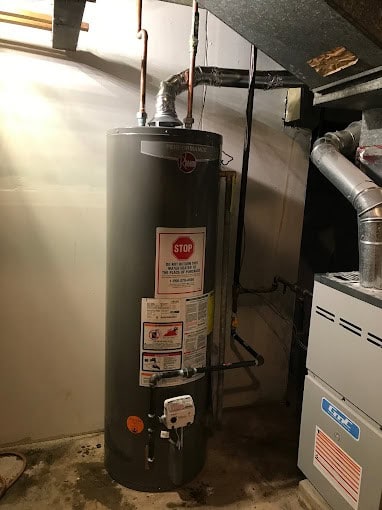
A traditional tank water heater keeps 40 to 50 gallons of water hot around the clock, whether you need it or not. That constant reheating — called standby heat loss — is where a significant chunk of your energy bill quietly disappears every month. Water heating accounts for roughly 20% of the average home’s energy use, and most of that goes toward maintaining temperature in a tank that sits idle for hours at a time.
A tankless water heater works differently. When you turn on the hot water tap, a sensor detects the flow and fires up the heat exchanger — heating the water directly as it passes through. No stored water. No standby losses. The U.S. Department of Energy estimates tankless systems can be 24% to 34% more energy efficient for homes that use 41 gallons or less per day. For higher-use households, that figure still lands around 8% to 14%.
The other major difference is lifespan. Most tankless units last 20 or more years, with replaceable parts that can push that even further. A standard tank heater typically gives you 10 to 15. Over the course of two decades, that’s one fewer full replacement — and one fewer chance for a failed tank to flood your utility room.

The phrase “endless hot water” is accurate, but it needs a little context. A tankless system heats water on demand, so it doesn’t run out the way a tank does. But it does have a maximum flow rate — measured in gallons per minute (GPM) — and if you exceed that, the water coming out won’t be as hot as you want it.
This matters most in larger households. Running two showers simultaneously while the dishwasher is going can push a single unit past its capacity. Proper sizing is the fix — and it’s not complicated when done by someone who knows what they’re doing. We calculate your peak demand and select a unit that can handle it.
There’s also something called the “cold water sandwich” — a brief burst of cold water that can occur between uses in certain tankless configurations. It happens because residual hot water sits in the pipes, then cold water follows before the heater catches up. A recirculation pump eliminates this issue entirely, and it’s a straightforward add-on during installation.
One more thing worth knowing: tankless water heaters do require some maintenance. They’re not set-and-forget. In Cook County, where water from Lake Michigan carries moderate mineral hardness — roughly 8 to 10 grains per gallon — scale builds up inside the heat exchanger over time. Annual descaling keeps the system running efficiently and protects the unit’s lifespan. Skip it for a few years and you’ll notice the difference in both performance and energy bills.
None of this makes tankless a bad choice. It just means the system works best when it’s sized right, installed correctly, and maintained consistently — which is exactly what separates a good installation from one that leaves you disappointed two winters from now.
Here’s something most national buying guides won’t tell you: the colder your incoming groundwater, the harder a tankless unit has to work. In Phoenix or Atlanta, incoming water might sit at 60°F or higher year-round. In Cook County, that same water can drop to 35 or 40°F during a polar vortex. To deliver a comfortable 110°F shower, your tankless unit needs to raise the water temperature by 70°F or more — a much steeper climb than most of the country ever deals with.
An undersized unit will struggle to keep up during the coldest weeks of the year. You’ll notice it as lukewarm water during peak demand — exactly when you need it most. This is one of the most common complaints from Cook County homeowners who bought a tankless system without accounting for local climate conditions, and it’s entirely avoidable with proper sizing from the start.
The fix isn’t complicated: we account for Chicago’s temperature rise requirements when selecting a unit. Gas tankless heaters — the most common choice given that 80% of Chicago homes run on natural gas — typically need to deliver between 140,000 and 199,000 BTUs for whole-house applications. That’s a meaningful spec, and it’s one reason why who installs your system matters as much as which brand you choose.
Cook County’s older housing stock adds another layer. Many homes — especially in Chicago’s established neighborhoods and inner-ring suburbs — were built before 1940. The gas lines feeding those homes were sized for the original appliances, not a high-demand tankless unit. In many cases, a gas line upgrade is part of the installation. Same goes for homes considering electric tankless systems: a whole-house electric unit draws significant amperage, and older homes with 100-amp panels often need an upgrade before installation can proceed. These aren’t reasons to avoid tankless — they’re just things to assess upfront, before the work begins, so nothing surprises you mid-project.
Want live answers?
Connect with a Go-Rooter Emergency Plumbers expert for fast, friendly support.
National cost averages are a starting point, but they don’t tell the full story for Cook County homeowners. Chicago’s cost of living runs about 12% above the national average, and that flows directly into labor rates for licensed plumbing work. The installed cost of a tankless water heater in the Chicago area typically falls between $2,000 and $8,500, depending on the system type, the condition of your existing infrastructure, and whether additional work — gas line upgrades, venting, electrical panel changes — is needed.
That’s a wide range, and it’s intentional. A straightforward gas tankless swap in a home with adequate gas supply and proper venting sits at one end. A full conversion in a 1920s two-flat with undersized gas lines and old venting sits at the other. The only way to know where your project lands is an honest assessment from us — not a ballpark from a website.
For most Cook County homeowners, the choice between gas and electric tankless comes down to what’s already in the house. With 80% of Chicago-area homes on natural gas, gas tankless is usually the natural path — and the installed cost for a whole-house gas tankless water heater typically runs $2,100 to $5,600, covering the unit, labor, and any required modifications to gas supply and venting. If the gas line needs to be upsized, budget for that separately; it’s a common requirement in older homes and adds to the total, but it’s not a dealbreaker.
Electric tankless installation tends to run $1,400 to $3,000 for the unit and labor — lower on paper, but the caveat is real. Whole-house electric tankless systems draw substantial amperage. If your home has a 100-amp panel, you’ll likely need an upgrade to 200 amps before the system can run safely. That electrical work can add $1,500 to $3,000 to the project, which closes the gap with gas fairly quickly. For point-of-use applications — a single bathroom or a kitchen sink — electric tankless is a leaner, simpler option that doesn’t require the same electrical capacity.
Labor alone for a tankless water heater installation runs $600 to $2,500, depending on complexity and time on site. A straightforward swap might take three hours. A full conversion with gas line work, new venting, and permit processing takes longer. In Cook County, all water heater replacements and relocations require a permit — and we handle that process as part of the job. It’s not optional, and skipping it creates real problems down the road: failed home inspections at resale, voided warranties, and potential insurance complications.
If upfront cost is the main concern, a traditional tank replacement looks cheaper — and it is, in the short term. Replacing a 50-gallon gas tank water heater typically runs $882 to $1,810 nationally, with Chicago-area pricing on the higher end of that range. The job is simpler, faster, and requires less infrastructure assessment.
But the 10-to-15-year lifespan of a tank heater means most homeowners replace it twice in the time a tankless unit runs once. Add in the energy cost difference — tankless systems use 30% to 50% less energy than tank models — and the long-term math shifts. The DOE estimates annual energy savings of $40 to $100 per year with a tankless system. That’s not a dramatic number on its own, but over 20 years it compounds alongside the avoided cost of a second tank replacement.
The other factor that rarely gets discussed is risk. A tank holds 40 to 50 gallons of water under constant pressure. When a tank fails — and they all eventually do — that water goes somewhere. Basement flooding, water damage, ruined flooring — these are real costs that don’t show up in efficiency comparisons. Tankless units don’t carry that risk. There’s no tank to fail, no stored water to escape, and no water damage scenario tied to a slow, unnoticed leak.
For homeowners in Cook County’s older housing stock — the two-flats in Logan Square, the bungalows in Berwyn, the colonials in Oak Park — this isn’t a hypothetical. Aging tanks in tight utility spaces have caused real damage. The tankless upgrade isn’t just about energy savings. For a lot of homeowners, it’s about eliminating a risk they’ve been quietly living with.
Tankless water heater maintenance in Cook County centers on one critical task: descaling. The mineral content in Lake Michigan water — those 8 to 10 grains per gallon we mentioned earlier — accumulates inside the heat exchanger over time. Left unchecked, scale reduces efficiency, increases energy use, and eventually damages the unit beyond repair.
We recommend annual descaling for most Cook County homes. The process involves running a food-grade acid solution through the system to dissolve mineral buildup. It takes about an hour, costs between $150 and $300, and extends your tankless water heater’s lifespan by years. Skip this maintenance and you’re looking at a $500 to $1,000 repair — or a full replacement — within five to seven years. The math is simple: spend a little now to avoid a lot later.
Article details:
Share:
Continue learning:
Request a Callback
Want to skip the wait?
Simply enter your contact details, and we’ll call you when a NY Spine Advisor becomes available.