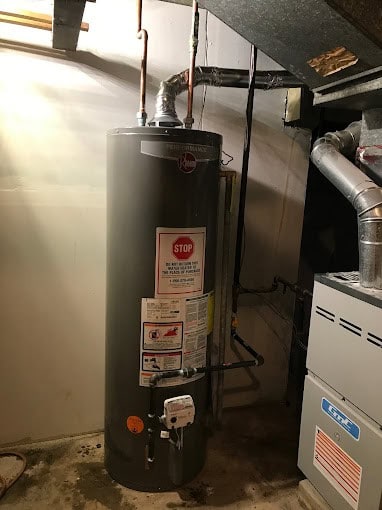
Cook County homeowners have more water heater options than ever — but the wrong choice can cost you hundreds a year. Here's how to pick the right one.
Share:
Request a Callback
Want to skip the wait?
Simply enter your contact details, and we’ll call you when a Go Rooter Advisor becomes available.
Summary:
If you’re standing in a cold shower at 6 AM in January, you’re not researching water heaters — you’re calling someone. But if you have a little time before that moment hits, this is worth reading. Cook County averages 105 days below freezing every year. That’s 105 days your water heater is working harder than it would almost anywhere else in the country. The type of unit you choose — and whether it’s properly matched to your home — can mean the difference between $100 and $600 a year in operating costs. Here’s what you actually need to know before making that call.
Electric water heaters are the most straightforward option for a lot of Cook County homeowners, especially if your home doesn’t have an existing gas line or your utility room is tight on space. They use heating coils to keep stored water at temperature — no venting required, no gas connection to worry about, and installation is generally less involved than gas.
The tradeoff is operating cost. A standard electric tank water heater runs roughly $400–$695 per year in electricity. That’s manageable, but it’s worth knowing before you commit. Electric models do tend to last longer than gas — up to 15 years with proper maintenance — which helps offset the higher annual cost over time.

Here’s where it gets specific to Cook County. A huge portion of Chicago’s residential housing was built before 1950 — bungalows, two-flats, greystones — and many of them are still running on 60- to 100-amp electrical panels. A standard electric water heater typically draws 30 amps on a 240-volt circuit. That’s not always a problem, but if your panel is already near capacity, you may be looking at an electrical upgrade on top of the water heater installation itself.
That’s not a reason to rule out electric — it’s a reason to have someone assess your panel before you decide. We’ve worked in enough Berwyn bungalows and Cicero two-flats to know that the electrical situation varies wildly from block to block, sometimes house to house. What’s straightforward in a newer Schaumburg build can turn into a half-day project in a 1920s Evanston home.
The other thing worth knowing: electric water heaters are more efficient in one specific sense — because they don’t vent combustion gases, no energy is lost through the flue. The heat goes directly into the water. That efficiency edge doesn’t always show up in your bill because electricity costs more per unit of energy than natural gas in most of the Chicago market, but it’s a real technical advantage if your electricity rates are low or you’re generating your own power.
If you’re in a condo, a newer construction home, or a property without gas service, electric is often the cleanest, most practical choice. If you’re in an older Cook County home with a smaller panel and existing gas infrastructure, it may not be the most cost-effective path — but it’s worth running the numbers with someone who knows what they’re looking at.
Heat pump water heaters are getting a lot of attention right now, and for good reason — they use roughly one-quarter the electricity of a conventional electric model. Instead of generating heat directly, they pull warmth from the surrounding air and transfer it into the water. The result is an operating cost around $100 per year, compared to $400 for standard electric resistance. That’s a $300 annual difference, and over 10–15 years, it adds up fast.
The efficiency ratings back this up. Heat pump water heaters operate at a Uniform Energy Factor (UEF) of 2.5 to 3.5. Some models, like the Rheem Performance Platinum Hybrid, reach a UEF of 3.88 — translating to up to 75% energy savings compared to a conventional electric unit. The federal Inflation Reduction Act also offers tax credits of up to $300 for qualifying heat pump water heaters, which helps close the gap on the higher upfront cost.
Here’s the honest Cook County caveat, though. Heat pump water heaters need ambient air above roughly 40–50°F to operate efficiently. If your water heater is in an unheated basement that drops into the 30s during a polar vortex, the heat pump mode will struggle and the unit will fall back on electric resistance heating — which defeats the purpose. This isn’t a dealbreaker. Many Cook County homes have basements that stay above 50°F even in January, particularly if the space is finished or partially conditioned. But it’s something you need to verify before buying one, not after.
The other consideration is space. Heat pump water heaters are taller and wider than conventional tanks, and they need several feet of clearance around them to draw in enough air. In a tight utility closet, that may not work. In a full basement with open floor space, it’s usually fine.
If the conditions are right — conditioned space, adequate clearance, existing electrical capacity — a heat pump water heater is genuinely one of the smartest long-term investments a Cook County homeowner can make. If the conditions aren’t right, forcing it creates problems that cost more to fix than the savings are worth.
Want live answers?
Connect with a Go-Rooter Emergency Plumbers expert for fast, friendly support.
Natural gas water heaters are the dominant choice across Cook County for a reason. Peoples Gas serves most of Chicago and the surrounding suburbs, so gas infrastructure is already in place in the vast majority of homes. Gas water heaters heat water faster than electric, recover more quickly after high-demand periods, and generally cost less to operate in a market where natural gas prices are lower per unit of energy than electricity.
A conventional gas tank water heater typically lasts 8–12 years. That’s shorter than electric or heat pump options, but the lower purchase price and operating cost often make the math work out. For large households that burn through hot water quickly, gas — particularly a tankless gas unit — is often the most practical solution.
Tankless gas water heaters heat water only when you need it, which eliminates the standby heat loss that conventional tank models suffer from — that slow, constant energy bleed of keeping 40–50 gallons of water warm around the clock. The efficiency gain is real. And unlike a tank unit, a properly sized tankless system won’t run out of hot water mid-shower when the in-laws are visiting.
The lifespan is another advantage. Tankless units frequently last 20 years or more, compared to 8–12 for a conventional gas tank. That longer service life changes the cost calculation significantly when you factor in the price of a second replacement over that same period.
The tradeoff is upfront cost and installation complexity. Tankless gas water heaters require a larger gas line in many cases, updated venting, and sometimes a dedicated gas meter upgrade for high-BTU units. In an older Cook County home with original gas infrastructure, that can add to the installation cost. It’s not unusual, and it’s not a reason to avoid tankless — but it’s something to price out honestly rather than discover mid-installation.
Flow rate matters too. A single tankless unit has a maximum gallons-per-minute (GPM) output. If two people are showering simultaneously while the dishwasher runs, a unit that’s undersized for the home will struggle to keep up. Proper sizing — based on your household’s actual peak demand, not just the number of people — is what separates a tankless system that works beautifully from one that becomes a source of frustration. This is exactly the kind of assessment we do before recommending anything, because the right answer for a three-bedroom Oak Park home is different from what works in a six-bedroom house in Wilmette.
For Cook County homeowners with existing gas service, a large household, or limited space for a tank, a well-sized tankless gas water heater is often the best long-term investment — provided the installation is done right the first time.
Solar thermal water heaters can cover up to 85% of a household’s hot water needs in the right climate. Phoenix, Austin, Los Angeles — those are the right climates. Cook County is not, and it’s worth being direct about that.
Solar thermal systems use collectors mounted on the roof to capture heat from sunlight and transfer it to your water supply. In a market with abundant sunshine and mild winters, the math is compelling. In Cook County, where cloud cover is frequent, winter sun is limited, and temperatures regularly drop well below freezing, solar thermal systems face real challenges. Antifreeze loop systems can protect the collectors from freeze damage, but they add cost and complexity. And during a Cook County winter — which can stretch from November through March — the system may be producing very little, leaving you reliant on the electric backup element most of the time anyway.
The upfront cost for solar thermal installation typically runs $3,000–$7,000. For that same investment in the Cook County market, a heat pump water heater paired with rooftop solar PV panels is generally a stronger return. You get the efficiency of heat pump technology year-round, and if you have solar panels generating electricity, you’re running your water heater on effectively free power during peak production hours. Industry sources note that this combination — electric heat pump plus solar PV — tends to outperform solar thermal in cold, cloudy climates, and it gives you more flexibility if you ever want to expand your solar system.
This doesn’t mean solar thermal is never the right answer in Cook County. If you have a south-facing roof with excellent sun exposure, minimal shading, and a strong preference for solar technology specifically, it’s worth a real conversation. But going in with accurate expectations matters. A system that underperforms because it wasn’t the right fit for the climate is a frustrating and expensive lesson. If you’re drawn to the idea of solar-powered hot water, talk through both options before committing to one approach.
The honest answer is that the best water heater depends on your home, your household size, your existing infrastructure, and your priorities — and those factors vary more in Cook County than most people realize. A pre-1950 Berwyn bungalow with a 100-amp panel and a finished basement is a completely different situation from a newer Schaumburg home with a two-car garage and updated gas lines.
What doesn’t change is this: water heating accounts for about 18% of your home’s total energy bill. Getting the type and size right isn’t a minor detail — it’s a decision that affects what you pay every month for the next 10–20 years. Rushing into a replacement without thinking it through costs real money.
If your unit has failed and you need help now, or if you’re planning ahead and want an honest assessment of what actually makes sense for your home, we’ve been doing this work across Cook County since 2001. We show up with upfront pricing, no overtime charges, and the experience to tell you what you actually need — not just what’s easiest to install.
—
FREQUENTLY ASKED QUESTIONS
**What type of water heater is best for my home?**
It depends on your home’s infrastructure and your household’s hot water demand. Gas tank water heaters are the most common choice in Cook County because natural gas is widely available and the operating costs are generally lower than standard electric. Heat pump water heaters offer the best long-term efficiency but require adequate space and a conditioned installation area — important in Cook County’s climate. The best starting point is an honest assessment of your existing setup before choosing a type.
**How long do water heaters typically last?**
Gas tank water heaters generally last 8–12 years. Electric tank models can run up to 15 years. Heat pump water heaters average around 15 years. Tankless units — gas or electric — can last 20 years or more because they don’t store and constantly reheat water. If your unit is approaching or past those ranges and showing signs of trouble, repair costs often exceed what the remaining lifespan is worth.
**Do I need a permit to replace a water heater in Cook County, IL?**
Yes. All water heater installations in Cook County require a licensed plumber and a building permit from the local authority having jurisdiction. Cook County also requires plumbing contractors to carry a state-issued Illinois Plumbing Contractor’s Registration license and $1 million in liability insurance. Unpermitted installations can create problems at resale and may void your equipment warranty — so it’s worth confirming your contractor is pulling the proper permits before work begins.
**Are heat pump water heaters worth it in Cook County winters?**
They can be — but location within your home matters. Heat pump water heaters operate most efficiently when the surrounding air is above 40–50°F. If your unit would be installed in an unheated utility room that drops into the 30s during a Cook County polar vortex, efficiency drops and the system falls back on electric resistance heating. In a conditioned or semi-conditioned basement that stays above 50°F year-round, a heat pump water heater is an excellent long-term investment for Cook County homeowners, especially with the federal tax credits currently available.
**How do I know if I should repair or replace my water heater?**
If the unit is leaking from the tank itself, replacement is almost always the answer — there’s no practical fix for a corroded tank. If the issue is no hot water or reduced output, it may be something simpler: a failed heating element, a bad gas valve, or a worn dip tube. Age is the other factor. Units over 10–12 years old that need a significant repair are often better candidates for replacement, since the remaining lifespan may not justify the cost. We assess the full situation before recommending anything.
Article details:
Share:
Continue learning:
Request a Callback
Want to skip the wait?
Simply enter your contact details, and we’ll call you when a NY Spine Advisor becomes available.