Sump pump costs in Cook County, IL vary widely depending on pump type, whether a pit exists, and if you need battery backup. Here's what to expect.
Share:
Request a Callback
Want to skip the wait?
Simply enter your contact details, and we’ll call you when a Go Rooter Advisor becomes available.
Summary:
If your basement has ever taken on water — or you’ve watched a neighbor’s flood out during a summer storm — you already know why people take sump pumps seriously in Cook County, IL. What most homeowners don’t know until they’re already dealing with a failed pump or a wet floor is how much the cost can swing depending on what they actually need.
A simple pump swap and a brand-new system with a pit, drainage, and battery backup are not the same project, and the price difference is significant. We’ll walk you through what you’re actually looking at.
The two most common pump types — pedestal and submersible — come with meaningfully different price tags, and the right choice depends on your basement, your water table, and how hard your system is going to have to work.
A pedestal pump sits above the sump pit with a pipe running down into it. It’s the less expensive option: unit costs typically run $75 to $400, and full installation (unit plus labor) generally lands between $300 and $800. They’re easier to access and service, but they’re louder, less powerful, and not well-suited to basements that see serious water volume.
A submersible pump sits inside the pit, fully submerged. Unit costs range from $100 to $800 depending on horsepower and features, and full installation typically runs $800 to $2,000. They’re quieter, more powerful, and better equipped to handle the kind of sustained groundwater pressure that Cook County’s clay-heavy soil creates. For most homes in this area, submersible is the practical choice — not just the premium one.

National cost guides are written for a generic American basement. Cook County, IL is not a generic situation.
The county sits on heavy glacial clay soil that doesn’t drain — it holds water and pushes it against your foundation walls and floor with consistent hydrostatic pressure. That means sump pumps here run more frequently than they would in a sandy-soil suburb somewhere else in the country. More run time means more wear, shorter lifespan, and a higher bar for what counts as “properly sized.” A pump that would last a decade in a drier climate may struggle here if it’s undersized for the volume it’s actually handling.
Then there’s the housing stock. A large share of Cook County homes — Chicago bungalows, two-flats, greystones — were built between 1900 and 1960, before sump pumps were standard. Many of these properties have no existing sump pit. When a homeowner in one of these homes searches for sump pump installation cost, they often assume they’re looking at a pump swap. In reality, they need concrete cutting, pit excavation, and full drainage installation. That’s a very different project.
The gap between those two scenarios is significant. Sump pump replacement cost in Cook County, IL — swapping a failed pump in an existing, functional pit — runs around $490, with a range of $420 to $550. Full new installation, including the pit and drainage system, runs around $2,200, with a range of $1,300 to $3,000. If you’re not sure which category your home falls into, that’s one of the first questions worth asking before anyone starts digging.
Permit requirements add another layer. Cook County requires a permit for sump pump installation, and contractors must be registered with the Cook County Department of Building and Zoning — which itself requires an Illinois Plumbing Contractor’s Registration license and at least $1,000,000 in liability insurance. That compliance isn’t optional, and any contractor who suggests skipping the permit is a red flag. It also adds a small amount to the project cost, but it’s the kind of cost that protects you — both during the work and if you ever need to make an insurance claim after a flood.
This is the question that catches a lot of Cook County homeowners off guard, and it’s worth spending a moment on because the difference is real and the confusion is common.
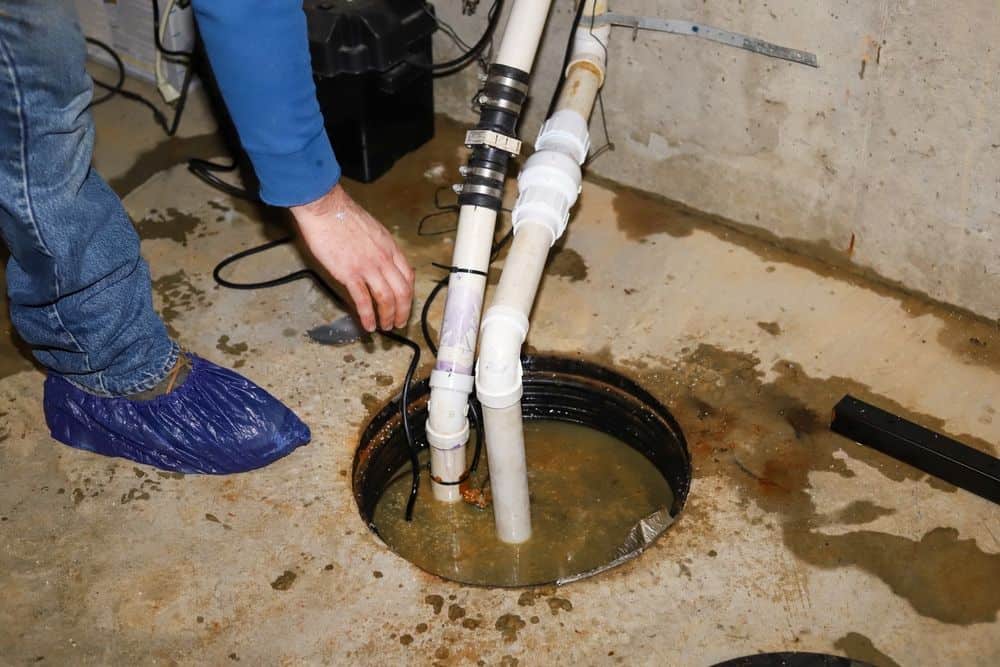
If your home already has a sump pit with functional drainage in place, and the pump itself has failed or worn out, you’re looking at a replacement. The existing plumbing and drainage don’t need to be touched. That’s why the cost is relatively contained — around $490 for most Cook County, IL homes, though the range runs $420 to $550 depending on the pump model and labor involved. Most sump pumps in Chicago homes last 7 to 10 years, so if yours is approaching that range and starting to struggle, replacement is the likely path.
If your home has no existing pit — which is true for a significant portion of Cook County’s older housing stock — you’re looking at a new installation. That means cutting through your basement’s concrete floor, excavating a pit at the lowest point of the basement, installing the liner, routing the discharge pipe to move water away from the foundation, and then installing the pump itself. It’s a more involved project, and the cost reflects that: $1,300 to $3,000, averaging around $2,200.
The confusion happens because both scenarios involve “getting a sump pump installed.” But the scope of work is completely different. Before you get a quote — or before you compare quotes from multiple contractors — it helps to know which situation applies to your home. We use camera inspections before starting work precisely because it removes the guesswork and ensures the scope we’re quoting is the scope the job actually requires. No surprises once the work starts.
Want live answers?
Connect with a Go-Rooter Emergency Plumbers expert for fast, friendly support.
Here’s the part that most cost guides skim over: a standard electric sump pump stops working the moment your power goes out. And in Cook County, IL, the storms that cause the most flooding are often the same storms that knock out electricity.
Chicago winters bring ice storms and high-wind events that routinely take down power lines. Summer supercell storms do the same thing. In both cases, groundwater is rising, your basement is at risk, and your pump is sitting there doing nothing. Battery backup isn’t a luxury add-on for cautious homeowners — it’s what makes the rest of the system actually work when you need it most.
Battery backup sump pump installation typically runs $600 to $2,000 when added to an existing primary pump that’s in good working condition. If you’re installing a complete system — primary pump plus battery backup together — the combined cost generally falls between $3,500 and $6,500 depending on the pump models, the complexity of the installation, and whether a new pit is involved.
The backup unit itself is a secondary pump that runs on a charged battery and activates automatically when the primary pump fails or loses power. With proper maintenance, those batteries last 10 or more years. The math on this is straightforward: a flooded basement causes an average of $25,000 in damage. The cost of a quality backup system is $600 to $2,000. That’s not a close call.
For Cook County homeowners specifically, the case for battery backup goes beyond general storm preparedness. More than 400,000 Cook County properties face flooding risk within 30 years — and that risk is growing. Illinois state climatologist Trent Ford has projected that the amount of rain falling in a 24-hour storm event could increase by another inch by 2050, and that even a quarter-inch increase can affect hundreds of people and cause millions of dollars in additional damage. The 2023 flooding that left flood survivors across Cook County still waiting for government assistance is a recent, real reminder of how fast things can go wrong. The July 2025 flooding damaged around 2,000 homes and severely affected more than 100 properties across the county. Battery backup doesn’t prevent storms. It just makes sure your pump keeps running through them.
Getting a quote that actually reflects your project — rather than a ballpark that doubles once work begins — comes down to a few things worth knowing before you call.
First, know whether you have an existing pit. If your basement has a sump pit already, tell us that upfront. It changes the scope significantly and should be reflected in the estimate. If you’re not sure, we’ll do a proper site assessment and check before quoting.
Second, ask about the permit. In Cook County, IL, sump pump installation requires a permit and a registered contractor. If a contractor quotes you a price and doesn’t mention the permit, ask directly. If they suggest skipping it, that’s a reason to call someone else. The permit process protects you — it ensures the work is inspected and documented, which matters both for your homeowner’s insurance and for any future buyer of your home.
Third, ask what the quote includes. Does it cover the pump, the pit liner if needed, the discharge pipe routing, the float switch, and post-installation testing? Or is it just the pump and labor, with everything else billed separately? Upfront, itemized pricing before any work starts is the standard you should expect.
We’ve been serving Cook County since 2001, and we’ve seen what happens when homeowners get surprised by scope creep mid-project. That’s why we use camera inspections before we start — to assess the existing drainage, confirm what the job actually requires, and give you a price that holds. We offer free quotes with no obligation, and we’re available 24/7 for emergency calls when waiting until Monday morning isn’t an option.
If you’re a new customer, we offer $40 off your first service. We also offer a 10% senior discount on residential plumbing under $2,500, and $300 off flood control installation for homeowners who need a more complete system — sump pump plus backwater valve — which is common in Cook County given that the flooding risk here comes from both groundwater intrusion and sewage backflow through the combined sewer system.
Sump pump installation cost in Cook County, IL isn’t one number — it’s a range that depends on what your home actually needs. A straight pump replacement in an existing pit runs $420 to $550. A full new installation runs $1,300 to $3,000. Battery backup adds $600 to $2,000 on top of that, and for most Cook County homeowners, it’s worth every dollar.
The biggest mistake people make is assuming they know which scenario applies to them before anyone’s actually looked at their basement. The second biggest mistake is hiring a contractor who skips the permit, underestimates the scope, or gives a number that changes once the work starts.
We’re ready to take a look at your basement and give you a straight answer about what your project will cost — based on what’s actually there, not a national average. Go-Rooter Emergency Plumbers offers same-day availability, upfront pricing, and no surprises.
Article details:
Share:
Continue learning:
Request a Callback
Want to skip the wait?
Simply enter your contact details, and we’ll call you when a NY Spine Advisor becomes available.