Cold water, error codes, strange noises — your tankless unit is trying to tell you something. Here's how to read the signs before things get worse.
Share:
Request a Callback
Want to skip the wait?
Simply enter your contact details, and we’ll call you when a Go Rooter Advisor becomes available.
Summary:
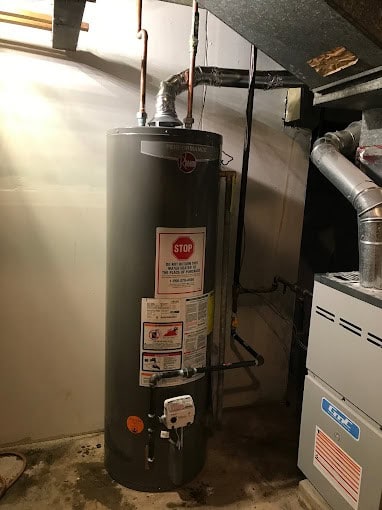
Your tankless water heater stopped working — or it’s acting strange — and now you’re staring at an error code, a cold shower, or a unit that keeps shutting off mid-use. Before you call anyone, or before you hit that reset button again, it helps to understand what’s actually going on. Not every problem is a disaster. Some are simple, inexpensive fixes. Others, if ignored long enough, become expensive ones. This guide breaks down the most common warning signs in plain language, so you know what you’re dealing with and what to do next.
Tankless water heaters are more communicative than most homeowners realize. When something goes wrong, the unit doesn’t just stop — it usually throws an error code, changes its behavior, or starts making a sound it didn’t make before. The problem is that most people don’t know how to read those signals, so they either ignore them or reset the unit and assume the problem is gone.
It isn’t. The error code clears, the hot water comes back, and the underlying issue keeps getting worse. What might have been a $200 repair becomes a $1,000 one. Understanding the warning signs early is the fastest way to protect both your comfort and your wallet.
Every major tankless brand — Rinnai, Navien, Noritz — uses a display panel to communicate error codes when something’s off. These codes aren’t random. They point to specific components: the igniter, the flow sensor, the heat exchanger, the venting system. The problem is that most homeowners see a flashing code, look it up online, find a dozen conflicting answers, and end up more confused than when they started.
Ignition failures are one of the most common repair calls we see. When your unit tries to fire up and can’t, it’s usually one of a few things: a worn igniter, a dirty flame sensor, a gas supply issue, or a venting problem that’s disrupting the combustion process. The unit shuts itself down as a safety measure. That’s actually the system working correctly — it’s telling you something needs attention before it can run safely.
Flow sensor problems are another frequent culprit, and they’re often misdiagnosed. The flow sensor tells the unit when water is moving through the system and triggers the heating process. When it gets dirty, corroded, or starts to fail, the unit either won’t fire at all or will cycle on and off erratically. In Cook County, where older homes often have aging galvanized supply lines, sediment and pipe scale can clog the inlet filter screen and put extra stress on the flow sensor — something that doesn’t show up as a problem until the unit starts behaving strangely.
The reset trap is real, and it’s worth naming directly. Resetting an error code without diagnosing the underlying cause is like turning off a smoke alarm without checking for fire. The code goes away, the unit runs for a while, and then the same code comes back — usually at the worst possible time. Repeated resets can also mask a worsening condition and, in some cases, void manufacturer warranties. If your unit is throwing the same code more than once, that’s a sign the problem needs to be diagnosed properly, not cleared again.
Chicago’s municipal water supply runs at approximately 7.5 grains per gallon of hardness. That’s enough mineral content to start affecting your tankless unit’s heat exchanger within months, not years — especially if annual descaling has been skipped. Scale accumulates on the heat exchanger’s internal surfaces, reducing its ability to transfer heat efficiently. The unit has to work harder to reach the set temperature, energy consumption goes up, and eventually the heat exchanger either fails or triggers a thermal overload shutdown.
The industry standard in a hard-water market like Cook County is annual descaling. Every-few-years maintenance isn’t sufficient here. If you’ve owned your tankless unit for several years and never had it flushed, the scale buildup is already happening — the question is just how much.
Venting blockages are a less-discussed but genuinely serious issue, particularly in Cook County’s older housing stock. Many homes in Chicago neighborhoods like Logan Square, Pilsen, Bridgeport, and Humboldt Park — and in suburbs like Berwyn and Cicero — were built before 1960. The exhaust venting on gas tankless units in these homes may be original or partially updated, and over time it can become partially blocked by debris, deterioration, or in some cases animal nesting. A blocked vent doesn’t just trigger an error code — it creates a combustion safety issue. The unit shuts down because it has to. If your gas tankless heater keeps throwing a venting-related error and you live in an older Cook County home, this is not a problem to reset and ignore.
Chicago winters add another layer of stress. When outdoor temperatures drop well below freezing — which happens regularly from November through February — the cold groundwater entering your unit drops significantly in temperature. The unit has to work harder to reach the set output temperature, which increases wear on heating components and raises the risk of thermal overload shutdowns. Uninsulated inlet pipes can partially freeze, causing pressure irregularities that confuse the flow sensor and trigger shutdowns. These are not unit defects. They’re the reality of running a tankless water heater in a Chicago winter, and they’re manageable with the right maintenance approach.
Want live answers?
Connect with a Go-Rooter Emergency Plumbers expert for fast, friendly support.
This is the question most homeowners are really asking when they search for tankless water heater repair. And it’s a fair one, because the stakes are real — a full tankless unit replacement installed typically runs $3,500 to $6,500, while most repairs fall somewhere between $75 and $1,300 depending on the component.
The honest answer depends on a few specific factors: the age of the unit, the nature of the failure, and whether the repair cost makes economic sense relative to what replacement would cost. We’ll walk you through that math before recommending anything.
Tankless water heaters are designed to last 15 to 20 years with proper maintenance — nearly double the 8 to 12 year average lifespan of a traditional tank heater. That lifespan advantage is one of the main reasons people invest in tankless systems in the first place. But it only holds if the unit is maintained and repaired when problems arise, not ignored until a minor issue becomes a catastrophic one.
As a general rule, if your unit is under 10 years old and the repair involves a single component — an igniter, a flow sensor, a flame rod, a pressure relief valve — repair is almost always the right call economically. The repair cost is a fraction of replacement, and the unit has years of useful life ahead of it.
If the unit is 12 to 15 years old and the heat exchanger has failed, the math gets more complicated. Heat exchanger replacement is one of the more expensive repairs, and at that age, you’re weighing the repair cost against the remaining lifespan of the unit. That’s a conversation worth having with a plumber who will give you a straight answer — not one who defaults to replacement because the margin is higher.
The average tankless water heater repair in Cook County runs around $567, with most homeowners paying somewhere between $218 and $916 depending on what’s involved. Minor component fixes can be as low as $75. More complex repairs involving the heat exchanger or control board can run higher. Knowing that range going in helps you evaluate whether the estimate you’re getting is reasonable.
Over 20 years, most homeowners replace a traditional tank system twice. A well-maintained tankless unit may only need one installation in that same timeframe. The long-term economics strongly favor repair when it’s a viable option.
If you’ve ever turned on the hot water tap after someone else just used it, and got a burst of warm water followed by a few seconds of cold water before the hot kicked back in — that’s called the cold-water sandwich effect. It’s one of the most common complaints among tankless water heater owners, and it causes a lot of unnecessary worry because most people don’t know if it’s a defect or just how the system works.
Here’s the short version: a brief cold-water sandwich is a normal characteristic of tankless systems. When the unit shuts off after use, a small amount of hot water sits in the pipes. The next person to turn on the tap gets that residual hot water first, then a brief shot of cold water while the unit fires up and reaches temperature, then hot water again. It’s not a malfunction.
But here’s where it gets important. If the cold-water sandwich is getting longer, more frequent, or more pronounced than it used to be, that’s a different story. An increasing cold-water sandwich can signal a flow sensor that’s starting to fail, scale buildup on the heat exchanger slowing the unit’s response time, or a recirculation pump that isn’t doing its job. In Cook County homes with hard water, scale is the most common culprit — the heat exchanger takes longer to reach temperature because its surfaces are coated with mineral deposits.
If you’ve had your unit for several years, live in the Chicago area, and the cold-water sandwich has been getting noticeably worse, it’s worth having the unit inspected. It may just need a descaling service. Or there may be a component starting to wear. Either way, catching it early is almost always cheaper than waiting until the unit stops working entirely.
If your unit is throwing a recurring error code, producing inconsistent hot water, making noises it didn’t used to make, or simply not working — those are all reasons to have it looked at by someone who knows tankless systems. Not reset. Not ignored. Diagnosed.
Cook County’s hard water, older housing stock, and harsh winters create conditions that are genuinely harder on tankless units than most of the country. That’s not a reason to panic — it’s a reason to stay ahead of maintenance and take warning signs seriously when they show up.
When you’re ready for a straight answer and same-day service, reach out to Go-Rooter Emergency Plumbers. We’ve been serving Chicago and all of Cook County since 2001, and we’ll tell you exactly what’s going on with your unit — and whether repair or replacement is actually the right move for your situation.
Article details:
Share:
Continue learning:
Request a Callback
Want to skip the wait?
Simply enter your contact details, and we’ll call you when a NY Spine Advisor becomes available.