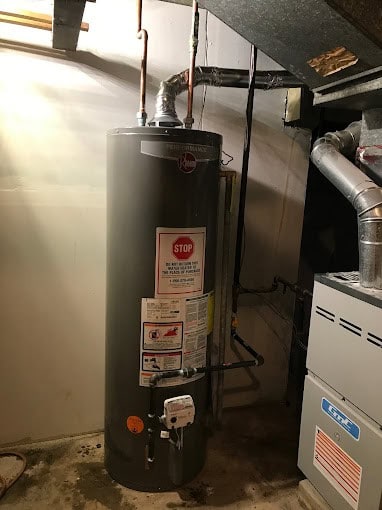
Wondering what water heater installation actually costs in Cook County? Here's what homeowners need to know before making a call.
Share:
Request a Callback
Want to skip the wait?
Simply enter your contact details, and we’ll call you when a Go Rooter Advisor becomes available.
Summary:
No hot water is one of those problems that makes everything else stop. Whether it happened this morning or you’ve been nursing a struggling unit for months, the first thing most homeowners in Cook County want to know is: what is this going to cost me?
That’s a fair question — and it deserves a straight answer, not a national average that has nothing to do with your area. This page gives you real local pricing, a clear look at what drives costs up or down, and honest guidance on whether repair or full replacement makes more financial sense for your situation. By the end, you’ll know exactly what to expect before you pick up the phone.
Here’s the short version: water heater installation in Cook County typically runs between $1,700 and $2,500 for a standard 50-gallon gas unit. Electric units fall in a similar range — $1,700 to $2,300 for the same size. If you’ve been reading national guides quoting averages around $1,333, that number doesn’t account for Cook County’s cost of living, which runs about 12% above the national average, or the dual-licensing requirements that apply to any plumber working within city limits.
Tankless systems cost more upfront — homeowners in Cook County generally pay $2,500 to $5,000 or more installed, depending on the complexity of the conversion. They’re more energy-efficient and can last over 20 years, but the premium over a quality tank unit often takes 10 to 15 years to recover in energy savings. That’s worth knowing before you commit.

The size of your water heater has a direct impact on what you’ll pay. Most Cook County households run a 40- or 50-gallon gas unit — the median household size is 2.2 people, so you’re rarely looking at the largest systems unless you’ve got a bigger home or high hot water demand.
Here’s a realistic range for gas water heater replacement in Cook County, installed by a licensed plumber with permits included:
A 30-gallon unit typically runs $1,300 to $1,800. A 40-gallon unit lands between $1,400 and $1,900. The most common size — 50 gallons — generally costs $1,600 to $2,500. Step up to a 60-gallon unit and you’re looking at $1,900 to $2,800. Larger 75- to 80-gallon systems can reach $2,600 to $3,300 or more.
Labor alone accounts for roughly half of your total cost. Licensed plumbers in Cook County typically charge $75 to $150 per hour, and a standard tank installation takes two to four hours. Tankless conversions are a different story — they can take six to ten hours and often require upgrades to your gas line or venting, which adds to the total.
Permits are part of the job, not an optional add-on. The City of Chicago uses its Easy Permit Program for straightforward like-for-like replacements, and most are approved same-day. Suburban municipalities across Cook County — Oak Park, Evanston, Skokie, Berwyn, Cicero — each have their own permit structures. Expect permit fees of $75 to $150 for a standard residential job. Any plumber who tells you permits aren’t necessary — or suggests you skip them to save money — is putting you at risk. Unpermitted installations can void your homeowner’s insurance coverage for water damage.
One more thing worth knowing if you’re in an older home: over a third of Cook County’s housing stock was built before 1950, and the median home in this county was constructed in 1961. Installations in these homes often involve aging venting systems, galvanized pipes, or gas lines that need evaluation before a new unit goes in. That doesn’t always mean extra cost, but it means you want a plumber who actually knows what they’re looking at — not one who’s used to cookie-cutter suburban installs.
A few factors consistently move the needle on what you’ll pay, and understanding them helps you have a more informed conversation with whoever you hire.
Fuel type is one of the biggest. About 80% of Cook County homes run on natural gas, and gas water heaters generally cost less to operate than standard electric units — saving homeowners roughly $273 to $317 per year compared to electric. If your home already has a gas line to the water heater location, you’re in good shape. If you’re switching fuel types or the existing gas line needs upgrading, that adds cost.
The condition of your existing venting system matters too. For gas-fired units, the installer needs to verify that the flue pipe is in good condition before reusing it. In older Cook County bungalows, two-flats, and courtyard buildings — the kinds of homes that define neighborhoods from Logan Square to Beverly — venting that’s been in place for 40 years may need attention. It’s not always a problem, but it’s worth a thorough look.
Your location within Cook County also plays a role in permit requirements and inspection workflows. Chicago proper operates under its own home-rule plumbing code, which differs meaningfully from the rest of Illinois. We work regularly across Cook County and know the differences. A plumber who doesn’t may quote you a price that doesn’t include what’s actually required.
Finally, the brand and warranty tier of the unit itself affects cost. A builder-grade water heater will run less upfront but may have a shorter warranty and lower efficiency rating. A mid-tier or premium unit costs more initially but often delivers better long-term value, especially when you factor in that water heating accounts for roughly 18% of a home’s total energy use. Choosing the right unit for your household — not just the cheapest one that fits — is worth a few minutes of honest conversation before the job starts.
Want live answers?
Connect with a Go-Rooter Emergency Plumbers expert for fast, friendly support.
This is the question most homeowners wrestle with, and the honest answer is: it depends on two things — the age of your unit and what the repair actually costs relative to replacing it.
The general rule of thumb is straightforward. If your water heater is 8 to 12 years old and the repair estimate comes in at 50% or more of what a new unit would cost installed, replacement is almost always the smarter financial move. You’re not just paying to fix a problem — you’re paying to extend the life of a system that’s already near the end of its useful life, with no guarantee it won’t fail again in six months.
That said, not every issue means you need a new water heater. A faulty thermostat, a failed heating element, or a bad anode rod are all repairable — and if your unit is only a few years old, repair makes obvious sense. The key is getting an honest assessment from someone who isn’t financially incentivized to sell you a replacement you don’t need.
Chicago winters are hard on water heaters. Cold incoming water temperatures force your system to work harder for longer stretches, and the combination of high demand and low temperatures accelerates sediment buildup and internal wear. A unit that might limp along for another year in a milder climate may not survive a January in Evanston or a February in Cicero.
There are a few signs that repair is no longer the right answer. Rusty or discolored water coming from your hot tap is one of the clearest — it typically means the tank itself is corroding from the inside, and no repair addresses that. A unit that’s making rumbling or popping sounds has likely accumulated significant sediment at the bottom of the tank, which reduces efficiency and accelerates wear. If you’re seeing water pooling around the base of the unit, that often indicates a crack or internal failure that can’t be patched.
Age is the most reliable indicator of all. A gas water heater that’s 10 or more years old and showing any of the above symptoms is telling you something. The average lifespan for a traditional tank unit is 8 to 12 years. If yours is on the back half of that range and something has gone wrong, replacement is almost certainly the more cost-effective path — especially when you factor in that newer models can be up to 20% more energy-efficient than the unit they replace.
One diagnostic tool that changes the conversation is a camera inspection. Rather than guessing at what’s going on with your system and the surrounding plumbing, a camera gives a clear picture of pipe condition, venting health, and any issues that could complicate a new installation. It’s the difference between a quote based on assumptions and one based on what’s actually there.
If your unit is relatively new and the issue is isolated, repair is worth exploring. Common water heater repairs — replacing a thermocouple, swapping out a heating element, flushing sediment, or replacing a pressure relief valve — typically run $150 to $500 depending on the part and the labor involved. These are reasonable investments on a unit that has several years of life left.
Where homeowners get into trouble is when they pay for a repair on an aging unit without asking the harder question: even if this fixes today’s problem, what’s the realistic lifespan of this water heater? A $400 repair on a 12-year-old tank might buy you another year — or it might buy you three months. That’s not a great investment when a new installed unit, with a manufacturer’s warranty and current energy efficiency standards, starts at $1,600 to $1,900 for a standard 40-gallon gas system in Cook County.
The other variable that doesn’t get discussed enough is the total cost of inefficiency. An aging water heater that’s still technically working may be costing you more in energy bills than you realize. If your unit is running constantly, taking longer to recover between uses, or struggling to maintain temperature during a Cook County cold snap, it’s working harder than it should — and you’re paying for that on every gas or electric bill. Sometimes replacement pays for itself faster than the math first suggests.
What we’d encourage any Cook County homeowner to do before committing to either path is get an honest, upfront assessment — one where the plumber walks you through the options, gives you a firm price before any work starts, and doesn’t push you toward a decision that benefits them more than it benefits you. That’s the standard we hold ourselves to on every call.
Water heater installation cost in Cook County is higher than what most national guides suggest — and now you know why. Between the cost of living premium, permit requirements, older housing stock, and the dual-licensing rules that apply to city work, there are real, local factors that shape what you’ll pay. Going in with accurate expectations protects you from both sticker shock and from being underquoted by someone cutting corners.
The most important thing you can do before any work starts is get a complete, written price — not an estimate that grows once the job is underway. That’s true whether you’re planning ahead or dealing with a failed unit at 11 PM on a Tuesday.
If you’re in Cook County and need a straight answer on what this is going to cost — or you need someone out there today — we’re available 24 hours a day, every day of the year, with no overtime charges and no surprise fees. Call Go-Rooter Emergency Plumbers and a real plumber answers.
Article details:
Share:
Continue learning:
Request a Callback
Want to skip the wait?
Simply enter your contact details, and we’ll call you when a NY Spine Advisor becomes available.