Most Cook County homeowners have never flushed their water heater, checked the anode rod, or tested the TPR valve. Here's what that's costing you.
Share:
Request a Callback
Want to skip the wait?
Simply enter your contact details, and we’ll call you when a Go Rooter Advisor becomes available.
Summary:
Most homeowners don’t think about their water heater until something goes wrong. That’s understandable — it sits in a utility closet or basement corner, does its job quietly, and never asks for attention. The problem is that in Cook County, quietly is exactly how it fails. The water here is hard. The winters are brutal. And a lot of the housing stock is old enough that the water heater in your basement may have been installed during a different presidential administration. We’ve put together this guide to cover the maintenance tasks that actually matter, why they matter more here than in most other markets, and what a professional service visit from us should actually include.
The phrase “water heater maintenance” gets used loosely, and that’s part of the problem. A lot of homeowners assume it just means checking that the unit is still running — maybe glancing at the pilot light or adjusting the thermostat. Real maintenance is more involved than that, and some of the most important tasks are ones most homeowners have never heard of.
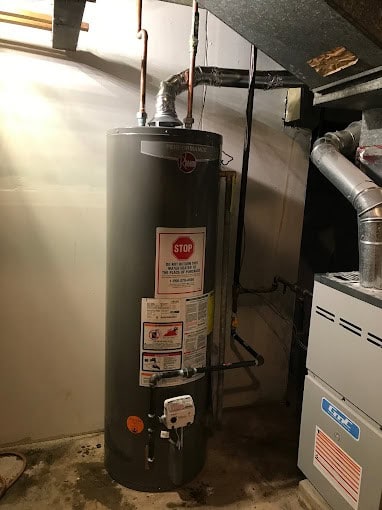
A proper annual water heater service covers tank flushing to remove sediment buildup, anode rod inspection, temperature-pressure relief (TPR) valve testing, thermostat calibration, a visual inspection for corrosion or moisture around fittings and the base, and — for gas units — a check of the gas line and vent. Each of those tasks has a specific purpose, and skipping any one of them leaves a gap that tends to show up later as an emergency.
Chicago’s water comes from Lake Michigan and measures between 8 and 10.7 grains per gallon — hard enough that mineral deposits accumulate in your water heater tank from the moment it’s installed. If you’re in a suburban Cook County community that draws from groundwater rather than Lake Michigan, the numbers get worse. Oak Forest, for example, clocks in at 15.8 grains per gallon, which puts it firmly in the “very hard” category.
What does that mean practically? Every time your water heater heats water, the dissolved calcium and magnesium in that water settle at the bottom of the tank as sediment. Over time, that layer thickens. It acts as insulation between the burner and the water, forcing the unit to run longer and burn more energy to reach the same temperature. The U.S. Department of Energy estimates that water heaters account for roughly 18% of a home’s total energy use — and a sediment-clogged tank can push that number significantly higher.
The rumbling or popping noise you might hear from an older water heater? That’s almost always sediment. Water trapped beneath the buildup heats, bubbles, and forces its way through. It sounds alarming, but the real damage is happening silently before it ever gets loud — in the form of reduced efficiency, accelerated corrosion, and a unit that’s working twice as hard as it should.
For Cook County homeowners, the standard national recommendation of flushing your tank once a year is a floor, not a ceiling. If you’re in a suburb with particularly hard water, twice a year is worth considering. The flush itself involves connecting a hose to the drain valve, letting the tank empty until the water runs clear, and refilling. It’s not complicated, but doing it right — and catching what comes out — is where we add real value.
If you’ve never heard of an anode rod, you’re not alone — and that’s exactly the problem. It’s a magnesium or aluminum rod that runs through the center of your tank, and its entire job is to corrode so your tank doesn’t. It attracts the electrochemical activity that would otherwise eat through the steel lining of your water heater. When the rod is gone, that corrosion turns its attention to the tank itself.
Most manufacturers recommend inspecting the anode rod every two to three years and replacing it when it’s more than 75% corroded or less than half an inch thick. In hard water conditions — which, again, describes most of Cook County — that timeline can move faster. A rod that might last four years in a soft water market can be depleted in two or three years here.
Replacing an anode rod on schedule is widely cited as the single most impactful maintenance action a homeowner can take. Done consistently, it can effectively double a water heater’s lifespan — pushing a unit that might otherwise fail at 10 years well past 15 or even 20. That’s not a minor efficiency gain. That’s the difference between a planned replacement on your timeline and an emergency call during a January polar vortex when every plumber in Cook County is booked.
The other task that gets skipped almost universally is TPR valve testing. The temperature-pressure relief valve is a safety device — it’s designed to open and release pressure if the tank overheats or pressure builds to dangerous levels. It should be tested annually by briefly lifting the lever and confirming it opens and reseats properly. If it doesn’t, it needs to be replaced. This is not optional maintenance. A stuck or failed TPR valve on an overheating tank is a serious safety issue, not a performance concern.
Want live answers?
Connect with a Go-Rooter Emergency Plumbers expert for fast, friendly support.
Tankless water heaters have become increasingly common in Chicago’s renovated homes and newer construction throughout Cook County suburbs. They’re more efficient, they last longer — up to 20 years with proper care — and they never run out of hot water mid-shower. But there’s a persistent myth that tankless units don’t need maintenance. They do. In Cook County’s hard water conditions, they may actually need it more urgently than a traditional tank.
The core issue is the heat exchanger. Scale from mineral deposits builds up inside it over time, and just one-eighth of an inch of scale reduces the unit’s efficiency by 30%. In a hard water market like ours, that scale can accumulate in as little as six to eight months without regular descaling. Homeowners who invested in a tankless system for its efficiency gains are quietly losing them — often without realizing it.
The standard recommendation from most tankless manufacturers is annual professional service. That includes descaling the heat exchanger, cleaning the inlet water filter, inspecting the gas pressure and burner, and checking the condensate system on condensing models. For homeowners in Cook County communities with very hard water, some manufacturers recommend descaling every six months.
The descaling process involves circulating a food-grade descaling solution through the heat exchanger using a pump and hoses — it’s not a DIY job for most homeowners, and it’s not something you want to skip. A heat exchanger that’s been neglected for several years in a hard water environment may be beyond descaling at that point, which means a costly component replacement or a full unit replacement.
Annual tankless water heater service typically runs $150 to $350. That’s a real number, and it’s worth putting in context: a heat exchanger replacement can cost several times that. A full unit replacement can cost significantly more. The math isn’t complicated — consistent annual service is the cheaper path by a wide margin, and it keeps the efficiency advantage you paid for when you chose a tankless system in the first place.
Many tankless water heater warranties require documented annual professional maintenance to remain valid. That’s not a fine-print technicality — it’s a condition that affects whether a warranty claim gets honored. Homeowners who’ve skipped service for a few years and then have a component failure may find their warranty has quietly lapsed for non-compliance.
There’s a right time to schedule water heater service in Cook County, and it’s not when the unit stops working. Fall — specifically September through November — is the ideal window for an annual maintenance visit. Cold inlet water temperatures in a Chicago winter force your water heater to work significantly harder than it does in summer. The unit is already under more stress from December through February.
If it’s going into that season with a thick sediment layer, a depleted anode rod, or a thermostat that’s running hot, the winter load accelerates whatever’s already wrong. Pre-winter maintenance is the difference between a planned service appointment in October and an emergency call in January when the temperature is below zero and your water heater finally gives out.
Spring is the second-best window — after a hard heating season, it’s worth having the unit inspected for any wear that accumulated over winter. Frozen supply line connections, stressed fittings, and components that were pushed hard during peak demand months are all worth a look before you head into a summer of lower scrutiny.
The seasonal angle matters especially in Cook County because Chicago winters are genuinely extreme. Average January lows around 16°F, with polar vortex events that push well below zero, create conditions that stress every mechanical system in a home. A water heater that’s been properly maintained going into that season handles it. One that hasn’t is working from a deficit before the season even starts.
As part of our preventative maintenance approach, we use camera inspections — something most local plumbers don’t offer in this context. A camera inspection can identify pipe corrosion in connected supply lines, sediment buildup that a flush alone won’t resolve, and early-stage issues in adjacent plumbing that would otherwise go undetected until they become something bigger. It’s the difference between maintenance that checks a box and maintenance that actually tells you what’s going on in your system.
If you’ve never had your water heater professionally serviced, the honest answer is that maintenance is overdue — especially in Cook County, where the water is hard, the winters are unforgiving, and a lot of the housing stock is carrying water heaters that are well into their second decade.
The good news is that none of this is complicated once you know what to look for. Annual tank flushing, anode rod inspection every two to three years, TPR valve testing, and a professional eye on the components that aren’t visible from the outside — that’s the full picture. For tankless owners, add annual descaling to that list and take the manufacturer’s warranty requirements seriously.
If you want a straight answer on where your water heater stands, Go-Rooter Emergency Plumbers offers free quotes, upfront pricing, and same-day service throughout Cook County. New customers get $40 off, and there’s a 10% senior discount on residential plumbing under $2,500. We’ve been doing this since 2001, and we’re not going to tell you that you need something you don’t.
Article details:
Share:
Continue learning:
Request a Callback
Want to skip the wait?
Simply enter your contact details, and we’ll call you when a NY Spine Advisor becomes available.